A History of Errors
Within the realm of spaceflight history, the Space Shuttle is the quintessential example of a great idea being sabotaged by fiscal austerity. While there are countless examples of space programs being canceled before they could deliver—NERVA is a notorious example, and the ISS itself was almost canceled back in the early 90s—few of them saw such an immense gap between promise and delivery. A launch vehicle that was supposed to drastically reduce the cost of getting people and payloads to space instead increased it, dragging much of America’s space program down with it for three decades and costing the lives of fourteen people in two preventable accidents. In both of these disasters, NASA’s safety culture was inhibited by the constant urge to increase the shuttle’s, exacerbating existing design flaws until the vehicle’s fatal failure was just a matter of time. Had a different design been chosen, I would suggest, the safety and utility of the space shuttle would not have conflicted to the same extent, taking the pressure off a harried and overburdened program administration.
However, if it was the fundamental design of the shuttle which set off so much of what followed, why was this design chosen in the first place? Space Shuttle history, being well-trod ground, offers us the following consensus: during phase B of the shuttle design process, which ran from around the middle of 1970 to the start of 1972, budget hawks in Congress and the White House forced NASA into a Shuttle design which minimized peak funding rather than total program costs, resulting in a vehicle which could not manage the necessary launch cadence to reach its already suboptimal cost-per-flight estimate. These fiscal pressures were well understood at the time, as can be seen from this graph produced by Rockwell in late 1971:
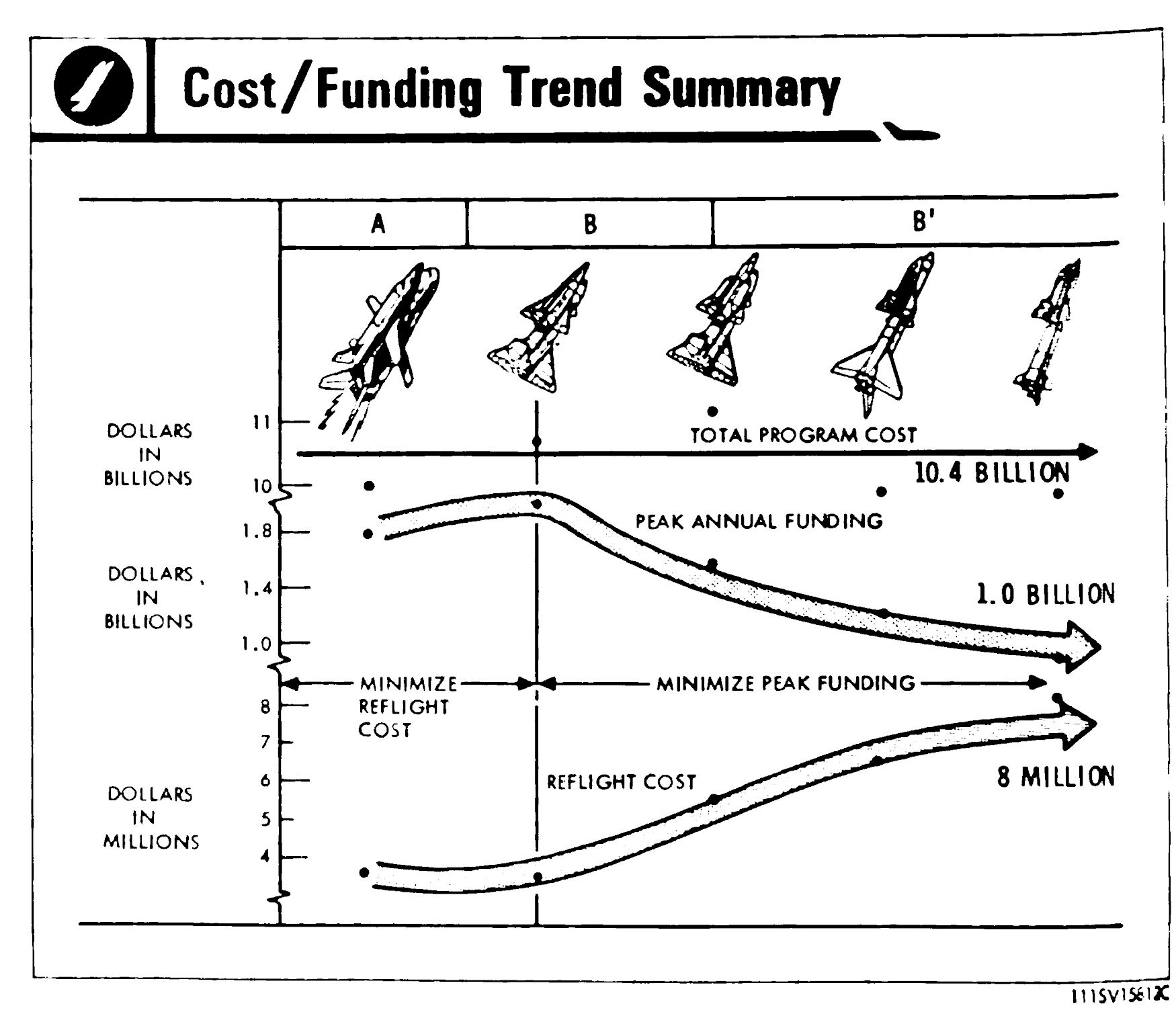
While this graph gives a good overview of the sometimes arbitrary budgetary decisions which governed the early shuttle program, it also suggests a parallel history of technical redesigns driven by these ever stricter constraints. It is the latter which I would like to expound on here, specifically because it allows me to ask another question of great interest to myself: given what we know now, what shuttle design should they have chosen instead?
To answer this question, we’ll need to focus on the pivotal moments within Phase B of the shuttle’s design program, which largely confines our focus to the year 1971. During this year, a program that was starting to get serious about defining the Space Shuttle (the ostensible point of a Phase B study) was extended twice over, forcing it into a process of rapid redesigning that initially produced brilliance, but was then compromised by excessive austerity. By the start of 1972, the program was practically incapable of delivering a good design; while there was still a battle to be lost on the question of the expendable booster stage, the brunt of the damage had been done.
Back in 1970 though, the situation looked great. NASA had solicited proposals for Phase B studies along a fully reusable two-stage-to-orbit architecture, where a vertically launched booster spaceplane would carry a smaller orbiter spaceplane most of the way to space before decoupling and flying back to the launch site. Four military-industrial consortiums stood ready to design and hopefully build such a vehicle. Each of these generally split the work of designing the booster and orbiter between two big firms, with some additional companies joining for specific parts or to add a specific kind of expertise, like the various airlines that were meant to prove the Shuttle was like an airliner itself. The four consortiums were:
- Grumman (Orbiter+Booster)
- Lockheed (Orbiter) and Boeing (Booster)
- North American Rockwell (Orbiter) and General Dynamics (Booster)
- McDonnell-Douglas (Orbiter) and Martin-Marietta (Booster)
Of these four, only the last two would win the initial Phase B contracts.
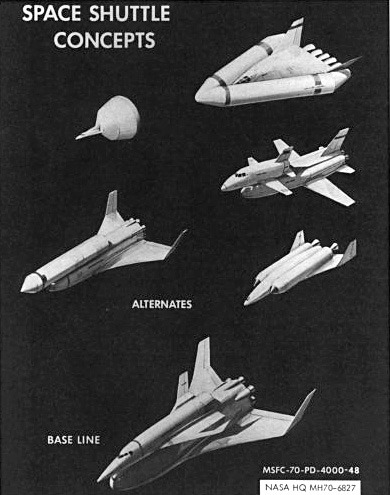
At the same time, though, the losing companies plus Chrysler would receive “Phase A Extension” contracts aimed at studying alternate space shuttle concepts. Boeing and Grumman would team up to study cheaper-to-develop designs using expendable tanks and/or first and second stages (such as the middle left and right on the image above) and eventually got a Phase B contract through this work after all. Lockheed would elaborate on their LS-200 design (top right) based on the old StarClipper—a large spaceplane with drop tanks that could get to orbit as a so-called ‘stage-and-a-half’ vehicle. Finally, Chrysler would keep working on its Project SERV (top left), a reusable single-stage-to-orbit (SSTO) vehicle which in no way resembled a Space Shuttle, though it could carry a small glider called the MURP.
The first big change to the overall design program came at the original end of Phase B around March 1971. Politically and fiscally, the fully reusable designs delivered by the McDonnell-Martin and Rockwell-GD teams looked increasingly untenable. By contrast, the parallel development work by Boeing and Grumman had produced a very attractive lower-cost design called the H-33. This vehicle would put the orbiter’s hydrogen fuel in two disposable side-mounted tanks, which made it so that the orbiter could either be a lot smaller or do more of the work of getting itself to orbit (or some combination of both). Either way, the new layout would considerably shrink the necessary size of the reusable booster stage, which could now separate from the orbiter at a lower velocity and endure less aerodynamic heating on the way back to Earth. This in turn meant that it could be built out of simpler materials, making it easier to maintain and cheaper to develop. Overall, the use of external hydrogen tanks kept per-flight cost about the same while reducing R&D costs by more than a billion, and these factors made it the standard for all Phase B Extension studies from April 1971 onwards.
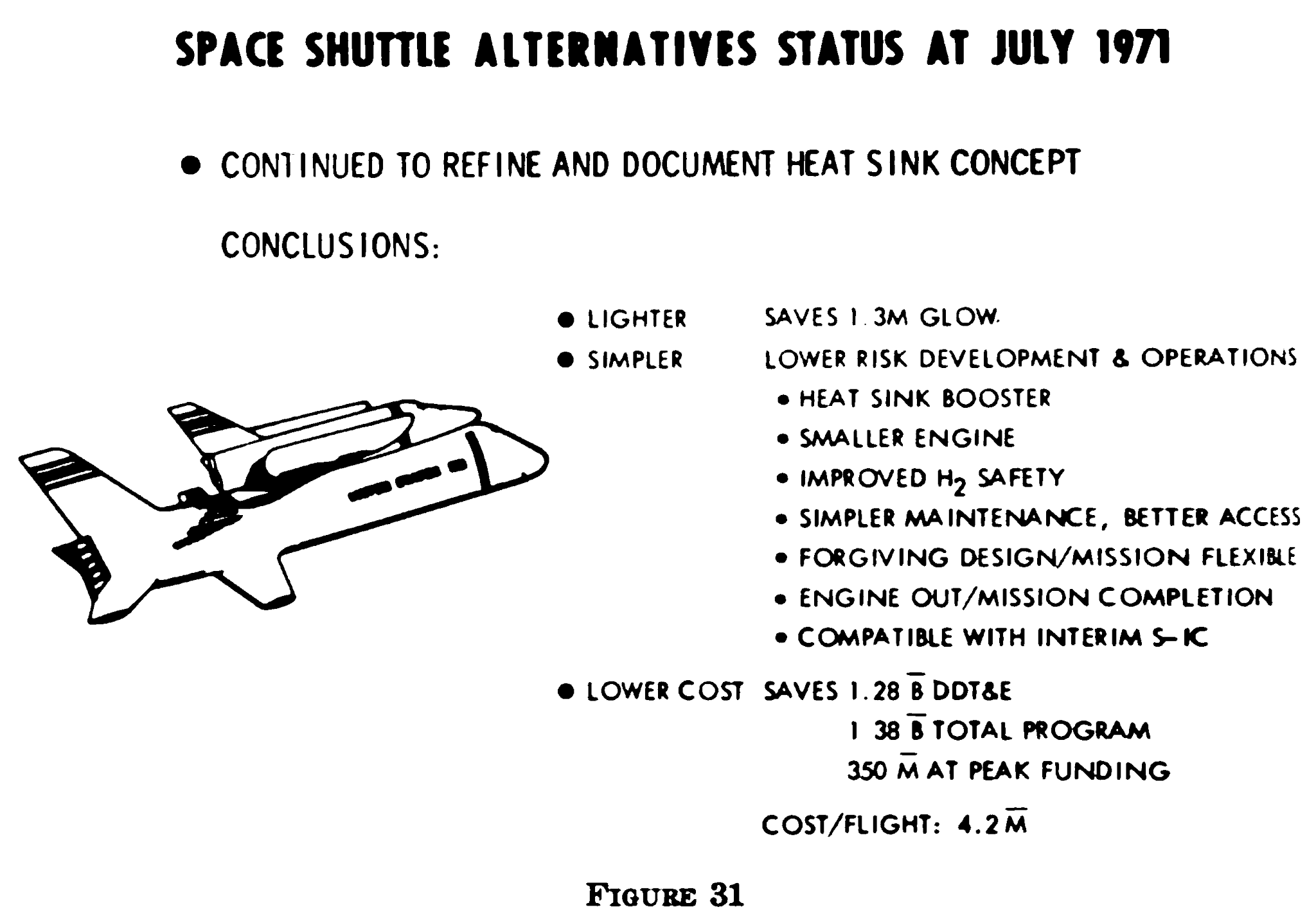
So far, so good. Externalizing the liquid hydrogen tank looked like a great move both technically and economically, and it seems likely that even a development with enough cash to fund a fully reusable shuttle would have seriously considered it. It would likely also have considered the next way to save on cost, which was to forego the development of new engines and instead use upgraded versions of the Saturn V’s J-2 and F-1 engines on the orbiter and booster respectively. This also meant that the booster would carry kerosene instead of cryogenic hydrogen, effectively making it into a winged version of the already existing S-IC stage. The “RS-IC” or “Flyback F-1” would become another major contender among the different configurations considered, lasting until the end of 1971 before being quietly discarded.
Even with the aforementioned changes, the White House remained dissatisfied with both the total and peak development cost of the shuttle. Plans to stretch development out over a longer period, either by splitting the orbiter’s into different phases or by using a temporary expendable booster, proved more trouble than they were worth. Instead, following new directions given around the middle of September, the logic of the external tank was pushed to its logical conclusion, with the additional removal of the orbiter’s internal liquid oxygen tank allowing for a further reduction in its size, albeit at a higher per-flight cost as both fuel tanks would now be thrown away.
As 1971 came to an end, the only design questions left concerned the type of fuel that would be used on the booster stage, and whether it would be fired in series or in parallel with the orbiter’s engines. Firing in series would have turned the orbiter into a second stage only, with the first stage being either the aforementioned flyback F-1 booster—which was ditched for cost-to-develop reasons—or else a recoverable but purely ballistic liquid or solid fueled design. Firing the booster and orbiter in parallel was usually called RATO (rocket-assisted take-off), TAOS (thrust-augmented orbiter shuttle) or TAHO (thrust-augmented hydrogen/oxygen tank), and proved to be the shuttle design we got. Even then, by the end of the second Phase B extension in March 1972, the series-fired liquid boosters still looked better in terms of total and per-flight cost than the parallel-fired solid ones, with the difference in (peak) development funding being exceedingly minor. For an example of this, see the Boeing-Grumman team’s chart below:
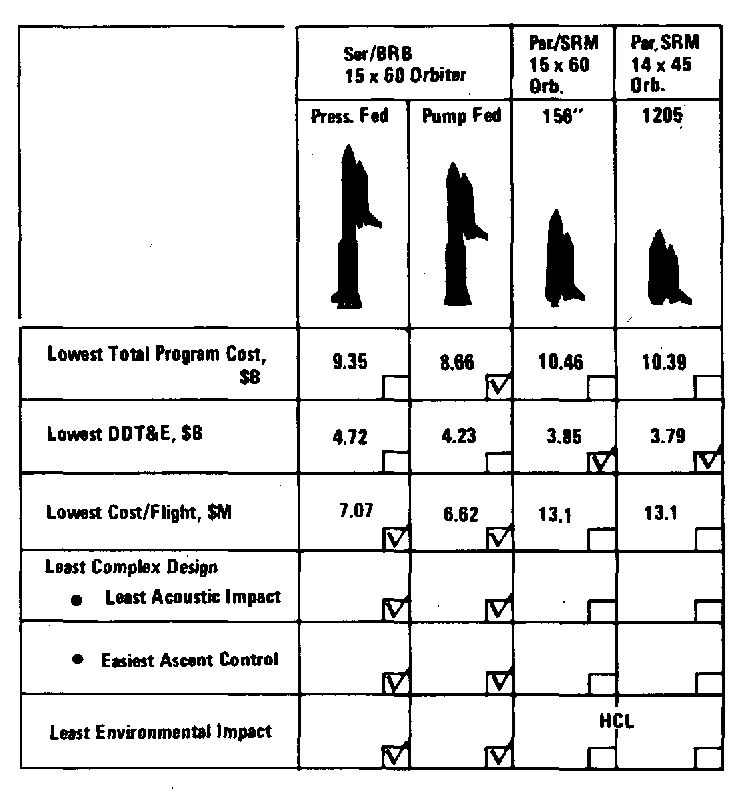
In the end, two factors can be said to have made the difference between these options. First, despite the evident cost advantages of liquid-fueled series-fired designs—being the safest of these designs as well—peak development cost remained an issue, and an arbitrary limit of 1 billion dollars cut out the liquid boosters by just a hair. Secondly, the potential refurbishment of the solid rocket boosters had not yet been priced in. If this could shave 20 to 40 percent off its recurring costs, as a study by Lockheed promised, then that could shave another million or two off the per-flight cost for a total of 10 million or less, bringing it close enough to the recoverable liquid boosters to make it worth the choice.
A Costly Endeavour
Was the Shuttle we got the wrong one to choose? Of course it was. But to know why, we must understand exactly how the Space Shuttle failed to live up to its promise. Too often, this issue is framed rather sensationally, simply dividing total program cost by the number of launches and ending up with a per-flight cost that is more than twenty times higher than what it was supposed to be. What this reading ignores is that the marginal cost to launch the shuttle was not all that high, as indicated by a zero base cost study of its operations performed in the 1990s:
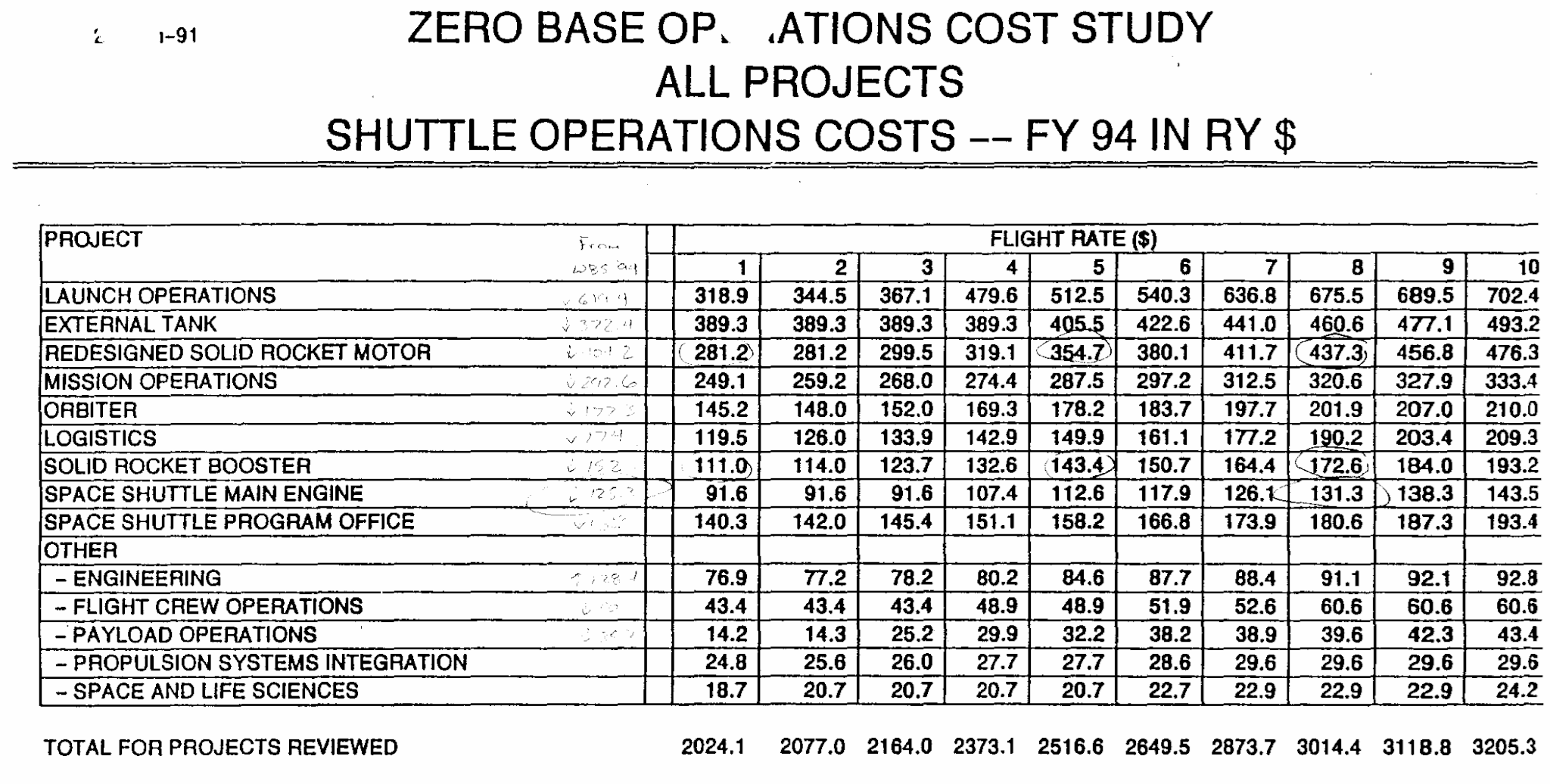
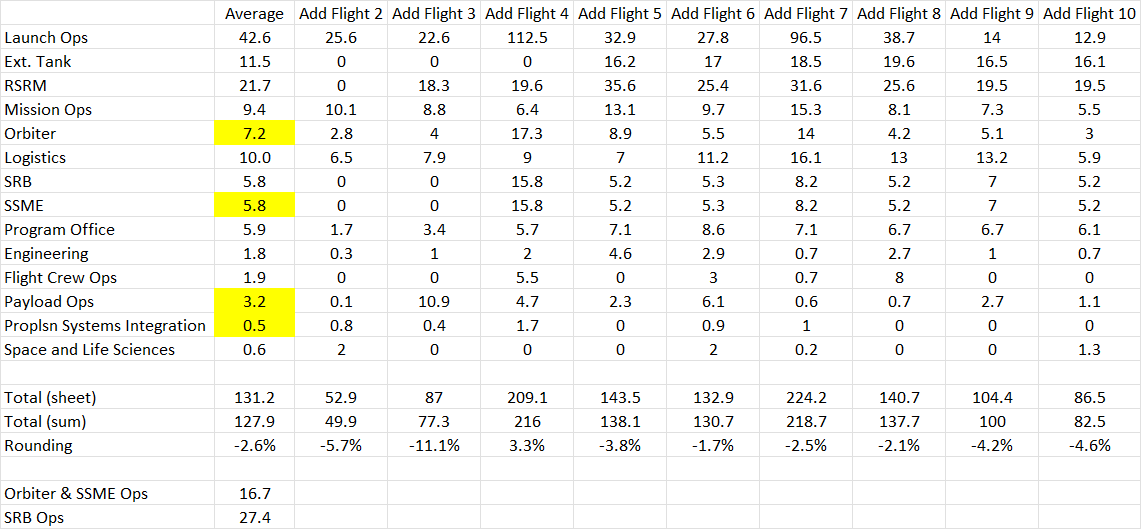
From the above we can derive the marginal cost (i.e. the cost of adding a shuttle launch to the manifest) to be around 130 million in 1994 dollars, meaning that the vehicle was only around three times as expensive as originally estimated by this measure. Why then was the average cost so much higher? The answer is launch cadence. No launch provider, not even NASA, is going to charge its customers anything close to the marginal cost if it has a large amount of R&D spending and annual fixed cost to earn back. As we can see, the fixed cost when launching 5 times a year was 75% of the total, and it was still close to 60% by 10 launches. Thus, launches had to go up drastically to make the enterprise worth it.
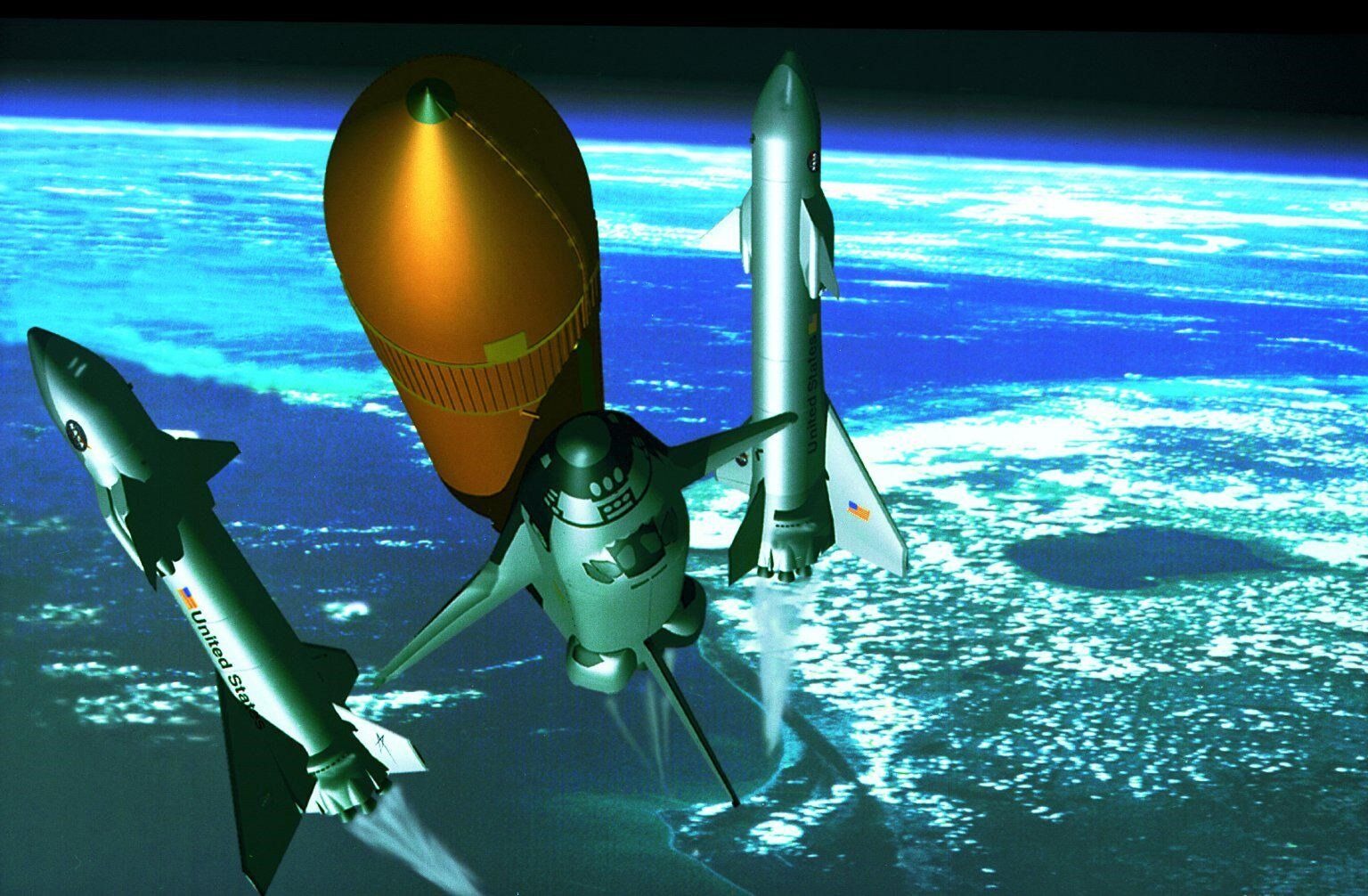
Historically, this makes for a bit of a paradox. If flying more space shuttles in a year was relatively cheap, there was no economic reason not to, quite the opposite in fact. What kept the shuttle stuck at its pitiful launch rate, then, were two contingent historical factors. The first was obviously safety: two orbiters plus their crews were lost during the program’s thirty-year history, each accident producing both a long shutdown and an immediate loss of a quarter of the total launch capacity. Although specific design changes could have prevented these losses, the rush to keep increasing launches was just as responsible, and could only have been managed if the way to reuse the shuttle had been simpler altogether. This brings me to the second issue, the total turnaround time of the architecture, which was equally hampered by the chosen design. For just one example, consider the solid rocket boosters (SRBs), which had to be fished out of the water, disassembled, put on rail cars to be refurbished in Utah, then returned to the launch site to be reassembled and stacked. Even if there were enough SRBs to be put on every launch, the contrast with a flyback booster—which would get back to base intact as part of the launch itself—was still remarkable. It’s therefore hardly surprising that liquid flyback boosters (LFBBs) for the existing Shuttle design were proposed up until the late 90s, promising considerable improvements in safety, operational cost, and turnaround time.
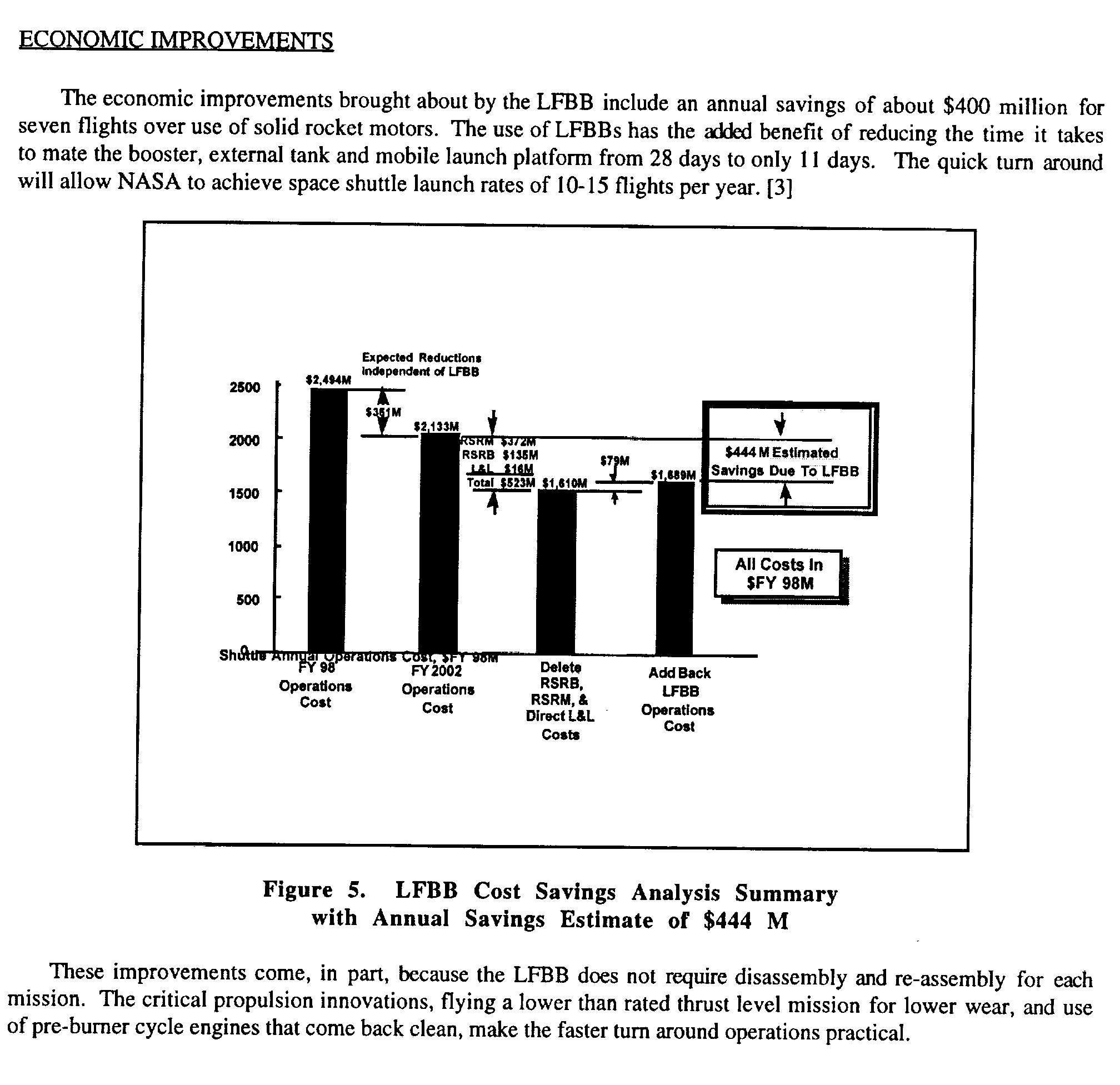
With these considerations in mind, it’s hard to escape the suggestion that even the existing shuttle could have been far more economical with a few common-sense changes. A fix for the SRB defect which destroyed the Challenger was already coming down the pipeline by the time of the accident, and with a bit of extra funding for a fifth orbiter, an additional launch pad on the West Coast, and some better processing facilities, perhaps an average launch rate closer to 20 rather than 5 could have been maintained. This is exactly what unfolds in “The Dream Survives”, an alternate history scenario where the space shuttle program does just a little better, and none of its major accidents prove fatal. While the latter would definitely depend on an ounce of luck, it goes to show that the program was not doomed from the start, and that sticking with the shuttle in spite of the understandable safety concerns—which was what really damned the whole affair, in my view—could have paid off economically. Interestingly, the Dream Survives scenario also involves the creation of a relatively conservative “Shuttle II” design, where new orbiters are built to be lighter and more maintainable, using the aforementioned LFBBs to make for a vehicle that could fly until the middle of the twenty-first century. While I am ambivalent about the prospects of such a design, it mirrors the trajectory of other long-lived aerospace projects like the B-52, and I have guesstimated its marginal cost as being close to what was promised for the original shuttle, around 175 million in 2026 dollars, based on the savings expected for a late-90s shuttle using LFBBs (though it could easily be cheaper than that based on the orbiter changes).
A Time For Choosing
All of this brings us back to that all-important question: what would the optimal Shuttle design have looked like? To figure that out, it’s worth looking at the zero base cost study once more, and see which elements of the design contributed the most to its total or marginal cost. Even a quick glance will tell us that it’s the solid rocket boosters (SRBs) and the external tank (ET), which makes a lot of sense if you consider that these are the least reusable components. While I used to think of the orbiter as an overexpensive hangar queen, it turns out that both it and its engine were still more economical than throwing away large fuel tanks and refurbishing solid rocket casings in Utah. I hereby apologize to the orbiters Columbia, Challenger, Discovery, Atlantis, and Endeavour.
What we’re looking for, then, is a shuttle design that minimizes per-flight cost by foregoing as many expendable elements as it can afford to. Unsurprisingly, this was already borne out by the existing design studies of the Phase B period, where more reusable designs consistently outperformed their cheaper-to-develop-but-less-reusable competitors. At the same time, a design which makes a minor concession on reusability to the benefit of development cost and risk would also be worth considering, if only because this makes it more plausible that such a program would be funded to begin with.
To help us choose between the various space shuttles proposed in the 1969-1972 period, I have consolidated the proposed program and per-flight costs of many different designs into the table appended at the end of this essay. While we should be careful about comparing such estimates to real economic data, I believe they can still be useful in relation to one another. Barring a few specific issues which I will address later, I don’t find much reason to believe that the cost overruns of one design would be wildly different from another. A more important question is whether they would be able to sustain the kind of launch rate that would let their per-flight costs be realized in practice, both by attenuating fixed costs and by amortizing the cost of development.
Before I reveal what I believe to be the optimal shuttle design, let me discuss some of the most interesting runners-up. As we have seen, the early space shuttle program was replete with all kinds of exotic spaceplane combinations, and it would be a shame to focus only on the most viable or conventional designs. The uncertainty around what a good shuttle would look like was what led NASA to the Phase A extension contracts to begin with, trying out some stranger configuration to see if that would lead to a breakthrough.
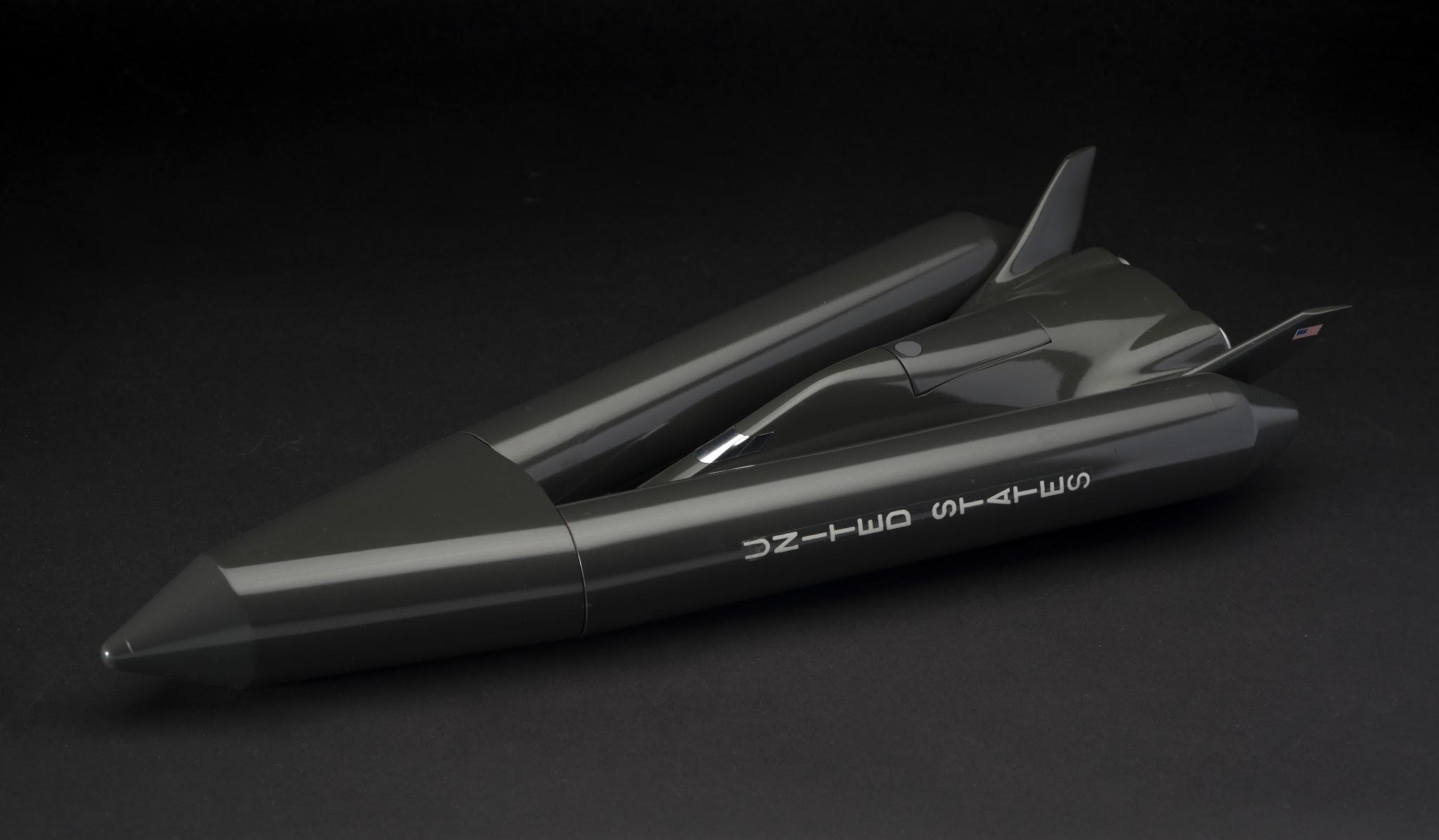
It is in this collection of odd ducks that we first find Lockheed’s LS-200, a “stage-and-a-half” design which ditches its large top-mounted external tanks partway through flight. Since these tanks are the only disposable component, the per-flight costs are competitive with the two-stage designs using a flyback booster and external hydrogen/oxygen tank. What keeps me from recommending it despite its low development cost is the Columbia problem. In case you don’t know, the 2003 accident which destroyed the orbiter Columbia was caused by a piece of foam insulation falling off the external tank during launch and hitting the orbiter’s silica-based thermal protection tiles, compromising them to such an extent that the aluminum structure underneath was destroyed during reentry. The accident exposed a serious and intractable problem, that being the inherent fragility of the thermal protection system (TPS). A design like the LS-200 would be all the more sensitive to it given the way the external tank is stacked above the vertically launching spaceplane. While TPS alternatives might mitigate the issue, the problematic combination of an aluminum airframe covered in silica tiles was specifically the one favored by Lockheed, given that they had done pioneering research into these tiles. With hindsight, this makes the LS-200 look like an accident waiting to happen.
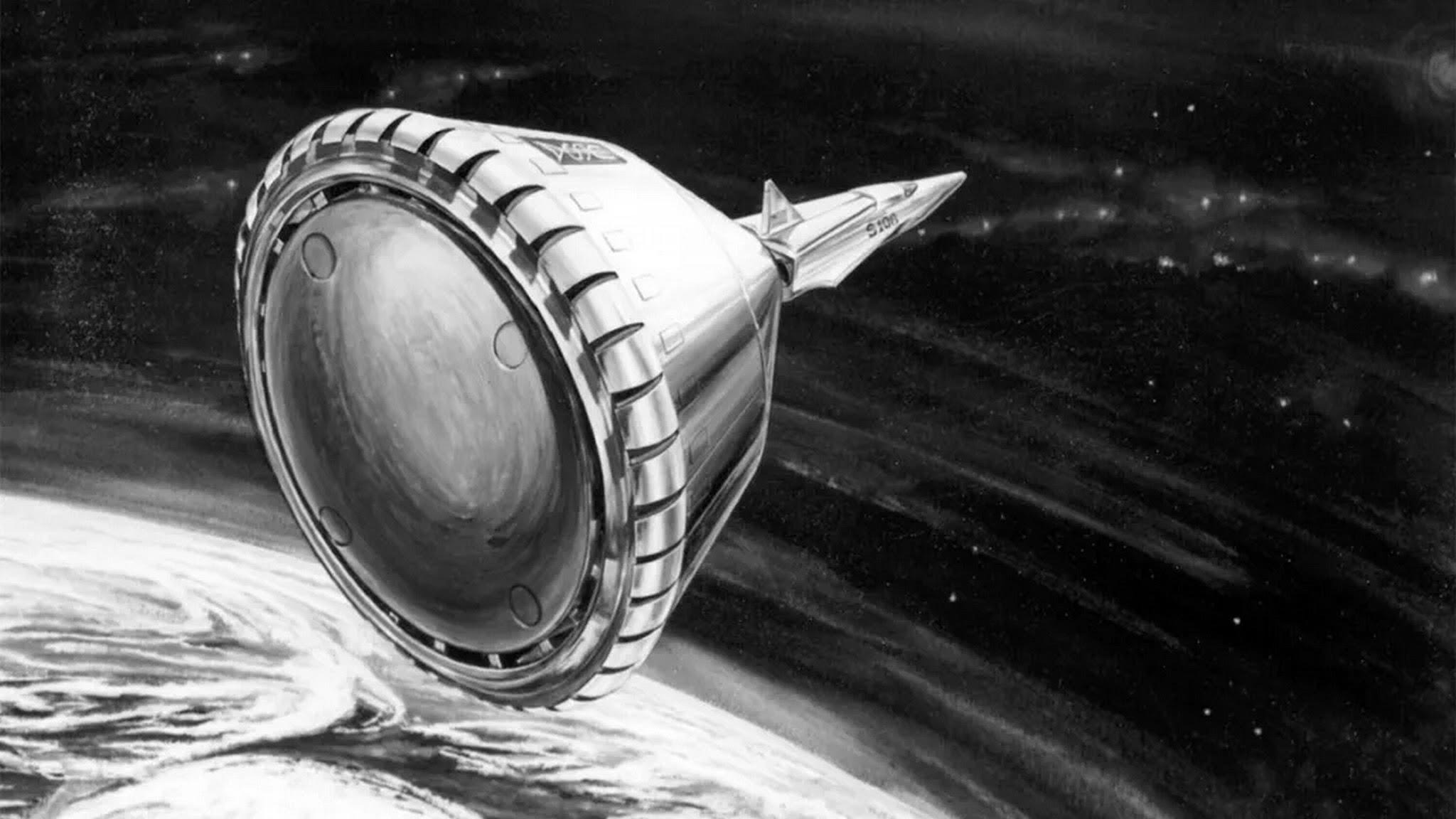
Another, even more unorthodox shuttle design came from the Chrysler company, whose aerospace division was nothing to sneeze at given their role in building the first stage of the Saturn IB. Their shuttle proposal was nothing like the Saturn though, nor did it resemble any design by their competitors. Instead, the Single-stage Earth-orbital Reusable Vehicle (SERV) was a bulbous rocketship that would launch and land vertically, carrying its payload to orbit without any concern for crossrange or crew capacity. If the latter factors had to be considered, the vehicle could carry the Manned Upper-stage Reusable Payload (MURP), a small spaceplane that made the total assembly look all the stranger. It is not hard to see why NASA passed on this design, or why I would consider it too speculative for its own good; besides the dubious nature of single-stage-to-orbit (SSTO) vehicles in general, the SERV in no way resembles the kind of vehicle anyone but Chrysler was interested in developing.
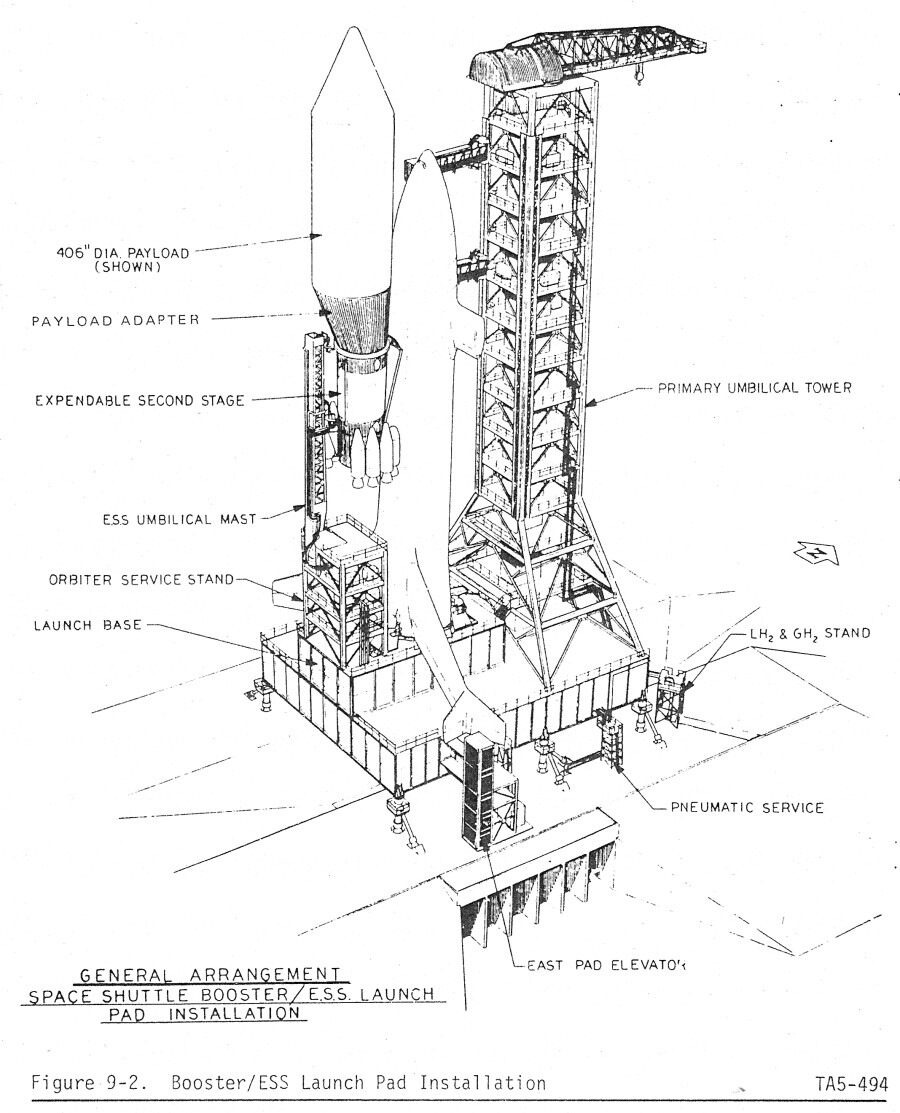
Finally, there is a design which wasn’t specific to any one company, but which could have offered a good fallback position if the space shuttle’s orbiter proved too difficult to develop. By attaching an expendable second stage to a flyback booster, the payload of the total vehicle could be increased significantly. It was even possible to adapt existing stages from the Saturn family to the architecture, or to derive the booster itself from the Saturn V’s first stage. In terms of cost per kilogram to orbit, the design is still competitive with the shuttle we got, and could have maintained a higher flight rate thanks to its eminently reusable first stage. Indeed, the concept seems like such an improvement over the shuttle we got that an entire alternate history narrative was dedicated to it, “Right Side Up”, where an S-IC-derived flyback booster is combined with an S-IVB-derived second stage and small optional glider to make for a very different kind of space shuttle. The scenario is well worth reading.
Having named all the shuttle designs I believe are interesting but still suboptimal, all that remains is for me to reveal the winner of this exercise in hindsight. If you paid attention to the history I laid out at the start, noted some of the requirements I mentioned earlier, and checked them against the table of costs, you may already know which design I prefer overall. If you guessed the Boeing-Grumman H-33, or any comparable system where hydrogen drop tanks allow a reusable orbiter to be combined with a smaller, simpler booster, then congratulations, you’re almost entirely correct. As noted before, the Boeing-Grumman team actually studied an even cheaper version of the basic hydrogen drop tank architecture which would forego the development of a new booster/orbiter engine in favor of the J-2S and F-1A, upgraded derivatives of the Saturn V engines. The use of kerosene on the booster would produce a heavier but smaller vehicle—incidentally avoiding the Columbia problem as well—and a staged development program allowed for a three-year testing period with older engines and a lower payload capacity before the full vehicle would come online. Since it also showed no appreciable difference with the H-33 in terms of per-flight cost, appearing to be a little cheaper in fact, I consider it to be the best shuttle among them all. Unfortunately, there are not too many images of this design to be found online. Below you can see one of them, a grainy illustration which still manages to show its similarity to the H-33 it is descended from. I’ve also added a contextual chart on shuttle design evolution, which helps to reinforce my suggestion that the program took a wrong turn around September 1971 (they accidentally swapped some of the illustrations, so I highlighted the correct one).
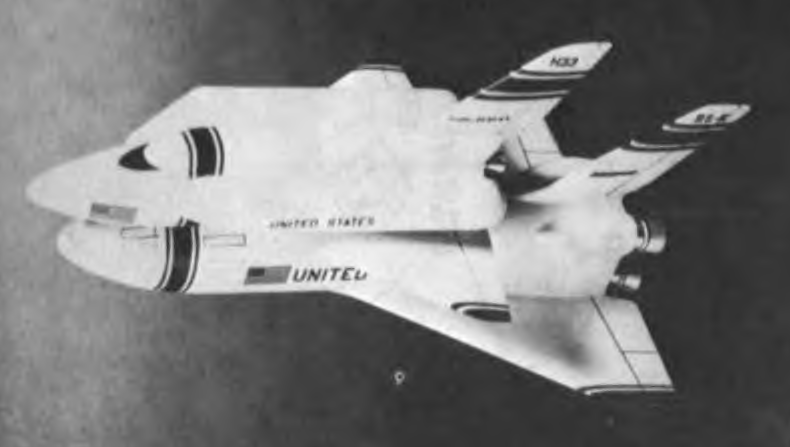
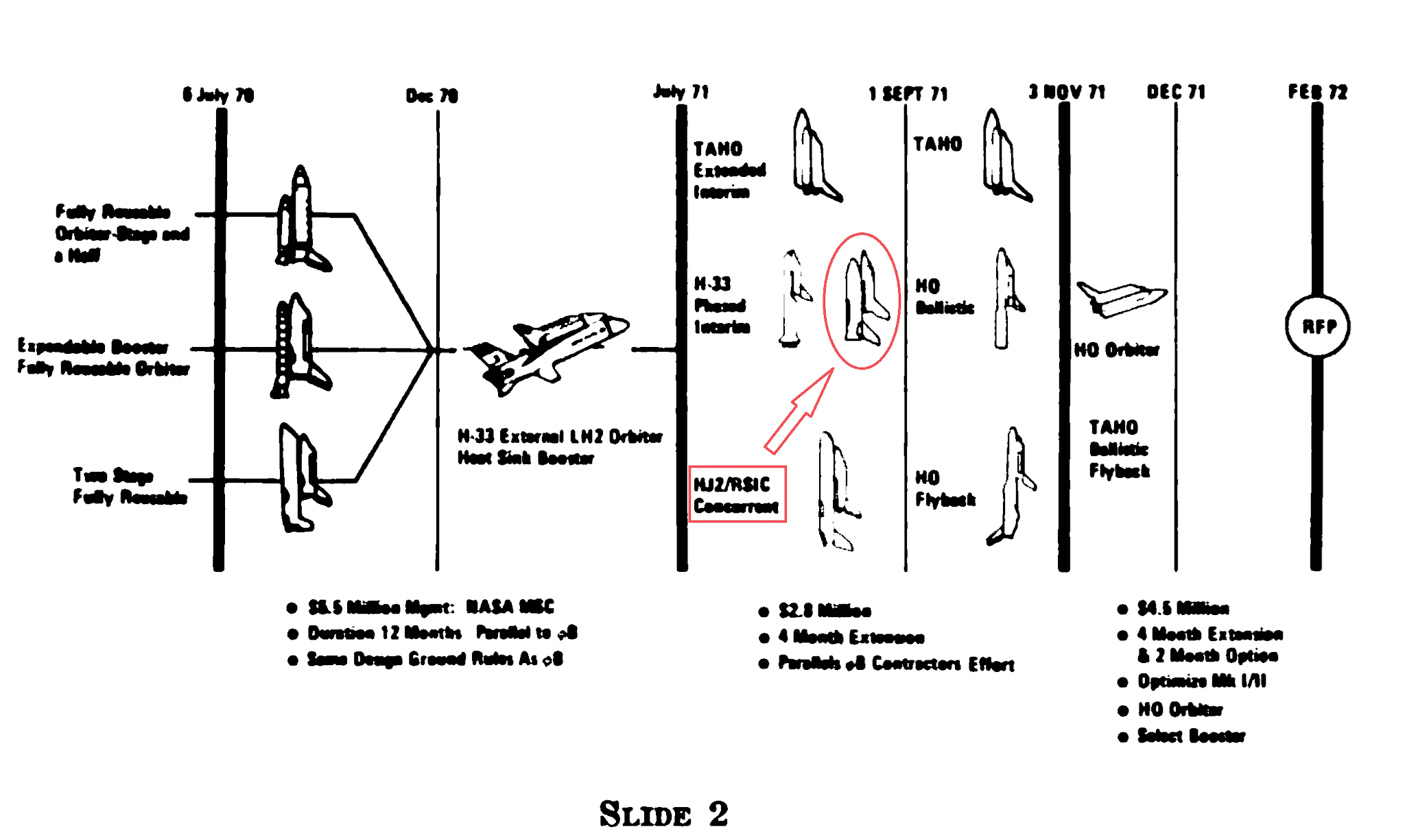
By the way, if you are or know any talented aerospace illustrators, I would love to see this Optimal Shuttle and some of its derivatives depicted with the fidelity they deserve
How Low Can We Go?
Now that we have our shuttle, though, another important question arises: what can we expect this vehicle to actually cost? The big issue with the historical space shuttle was that it cost far more than expected, and this is true even when we only consider its marginal cost—which is the sort of price commercial customers could expect to pay at a high launch cadence. The good news here is that the main concern at the time, that the research cost of a more ambitious shuttle would be too great to make up for its lower per-flight cost, was not much of an issue at all. If we convert the cost-to-first-flight of the actual space shuttle back to 1970 dollars (5.94 billion), and compare it to what a representative design was thought to cost (4.25 billion), the total cost overrun is only about 40%. As far as these things go, that is a bargain. If anything, it suggests a more ambitious program would have been better, as the resulting program would not have been burdened by excessive expendable elements like a full hydrogen-oxygen tank and ‘refurbishable’ solid rocket boosters.
Compared to the cost of getting any kind of shuttle flying, the cost of every individual flight and of annual operations as a whole appears to be the real problem with this kind of space launch system. And in fact, if we take what the chosen shuttle design was expected to cost—around 10 million per launch in 1971, or 96 million today—and put it up against the marginal cost indicated by the zero base study—100 to 150 million in 1994, or 230 to 350 million today—then we find an overrun of about 300% rather than 40%. In other words, the designers at the time had a much better grip on what it would cost to design the shuttle than what it would cost to operate it. As for why this is, I expect it to have much to do with the problem of launch cadence, which at a higher rate might have attenuated the marginal cost indicated over ten launches by providing an economy of scale in building the shuttle’s expended parts. That said, the problem appears to remain when comparing a speculative improved shuttle, like one with liquid flyback boosters, to its own equivalent from 1971. Here, the difference (170-180 million for the LFBB shuttle vs around 60 million for an F-1 flyback booster system) is still close to 300%. While the latter figure is far more uncertain, comparing a robust clean-sheet design to a hypothetical improvement on an ailing program, I believe it to be a good conservative measure if we want to adjust expected costs to what is ‘realistic’.
(I would also note that a factor of 3 is very much the worst-case scenario. If we use a different marginal cost for shuttle launches, such as the 63 million in 1985 dollars reported by astronautix or the even more optimistic number of 107 million in 2006 dollars seen here, then the degree of error is closer to 2.4 or 1.8, creating massive savings by math alone. On that note, we have been assuming that the per-flight costs quoted in 1971 are roughly equivalent to the marginal cost; while this makes sense at the launch rates they were expecting (up to 75 times a year, with around 450 flights in total), the real marginal cost could have proven to be somewhat lower, twenty percent or so. At the same time, this would also increase their error in estimating marginal or average cost by the same margin, so let’s stick with our assumption and that nice round number of 3.)
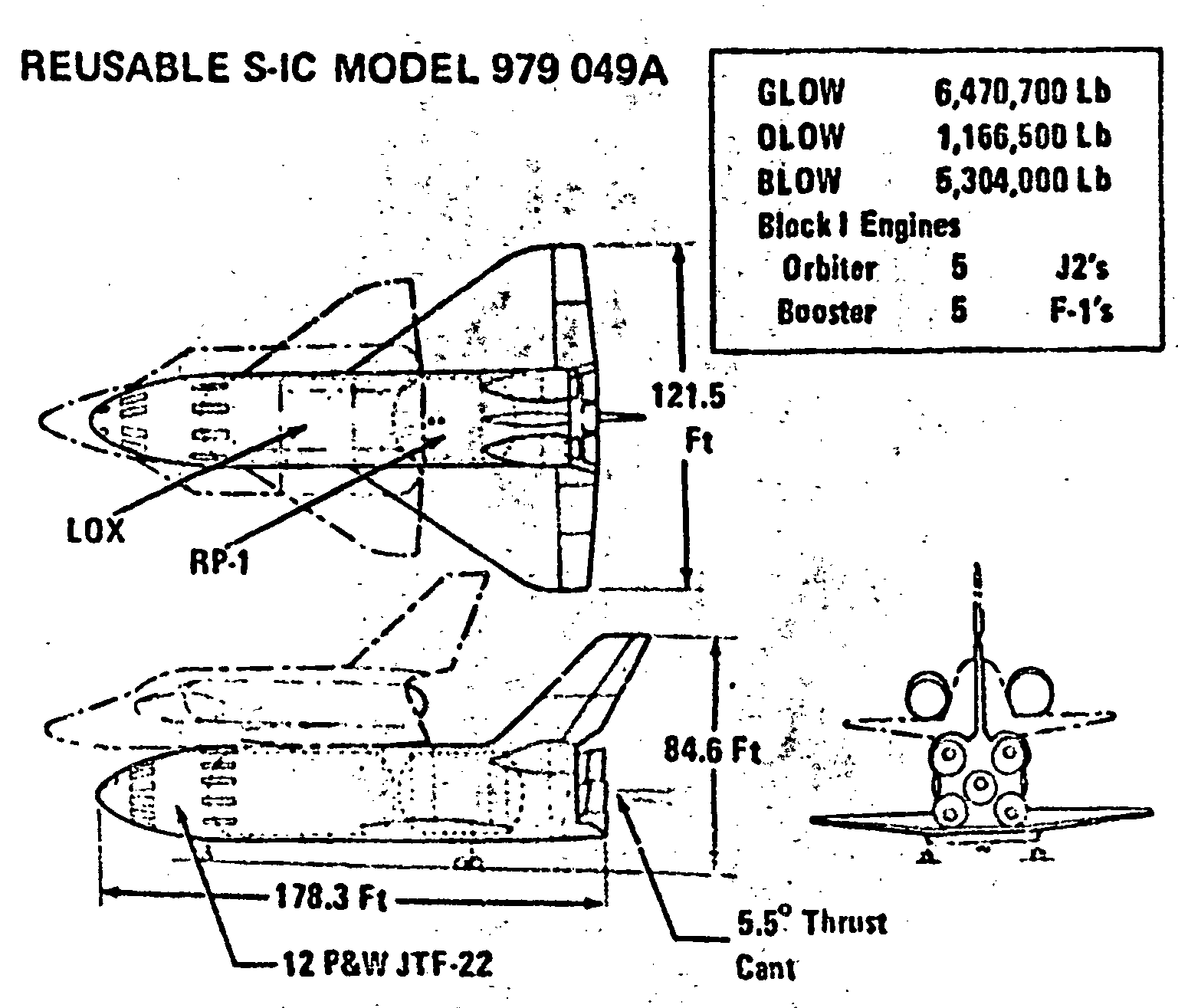
If we actually consider the engineering of it all, though, the idea that every shuttle design would be three times as expensive as promised grows dubious. It assumes that the engineers of the 1970s would be as bad at estimating the per-flight cost of the J-2S/F-1A system as the shuttle we got. However, there is good reason to believe that this design would be significantly less likely to exceed its per-flight estimates. First off, the methods of operation and reuse of our chosen booster are more conventional than what we actually got; while flying a massive winged rocket stage back to base is a challenge for sure, it does make it more like an airplane in terms of handling and maintenance, certainly when compared to the solid rocket boosters that have to be parachuted down, fished out of the ocean, and then cut up and sent by rail to Utah before the real work can begin. (As an aside, I do not keep hammering on this point because I hate the State of Utah or anything, I just find it to be an incredibly inefficient way of doing things.) It also makes the challenge of developing the booster more like that of the orbiter, not to mention all the things it has in common with the Saturn S-IC stage it is derived from.
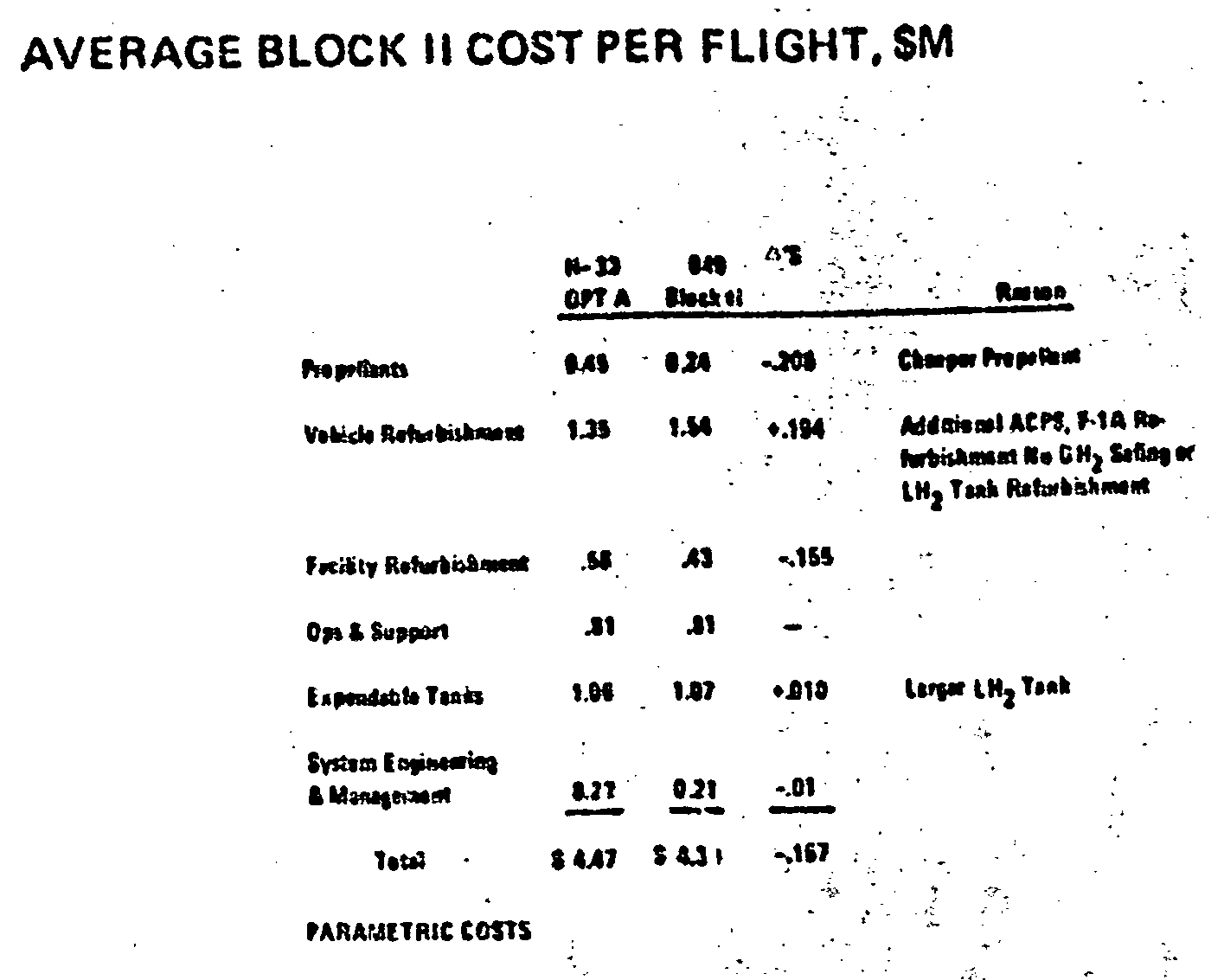
Speaking of hardware commonality, using F-1A and J-2S engines (instead of solid rocket boosters and the Space Shuttle Main Engine respectively) is just another way we’d be playing it safe in terms of developmental risk and operational complexity. While I thank the stars that the SSME turned out alright judging by its low contribution to shuttle marginal cost, the Saturn-derived engines we’re going with should be just as if not easier to handle, and much cheaper to develop as well. Even if we expect marginal cost to go up as the engines may have to be replaced more often, this may be offset by something as simple as the cheaper propellants used on the booster, as indicated by the Boeing-Grumman team’s own cost comparison of this design to the venerable H-33:
Really, it is the orbiter that I would be a bit more worried about, for the one we went with is more developmentally risky than the one we know in two distinct ways. On the one hand, by only externalizing the liquid hydrogen tanks, you’ll need to build a reusable liquid oxygen tank into the orbiter, and the dearth of knowledge in this area back in the 1970s could have been a source of trouble. That said, it’s much more manageable than trying to internalize the hydrogen tanks too, since these need to be much colder and bigger, and this is part of what spurred on the H33’s design in the first place. By contrast, it wouldn’t make much sense to try and externalize the orbiter’s liquid oxygen tank as well; it increases the launch cost by over half a million per flight, and you’ll need to learn to build a reusable version anyway owing to the booster stage.
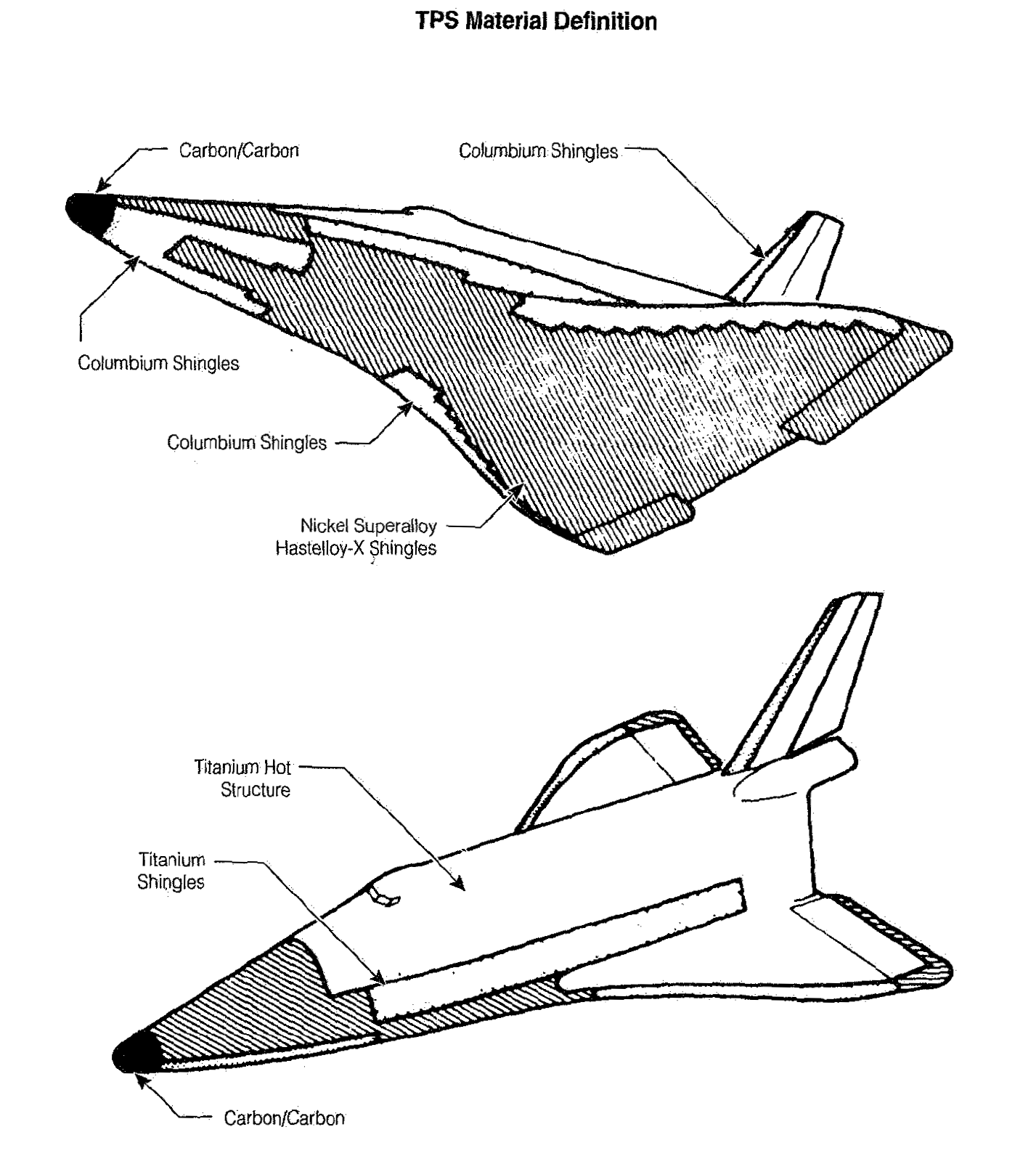
A second issue the orbiter might face is that of thermal protection. Though a bigger orbiter would usually require more of it, the shuttles studied by Grumman were generally to be built out of titanium, which has enough heat tolerance to not need any additional protection across its upper surfaces. For the underside, either the silica tiles just then being invented or some metallic equivalent would suffice. See this schematic by McDonnell Douglas for reference (it’s an orbiter with fully internal tanks, hence why the cockpit seems so small, but the basic layout should be the same):
Although the titanium fuselage has a lot to recommend it in terms of maintenance, total weight, and probably safety too, my worry is that it would lead to significant R&D cost overruns. Then again, since the choices we’ve made so far have largely lessened the likelihood of unexpected outcomes, one such choice (two if we count the liquid oxygen tank) should be worth it if in the long run it helps us to keep flight costs down and flight rate up.
From this digression into engineering, we return to the question of cost. Having already established that cost-to-first-flight of the real shuttle exceeded estimates by 40%, I believe it’s fair to apply the same metric to this design, as the additional uncertainty of one element is balanced out by another, and the basic increase is already accounted for. To get an accurate sense of what this shuttle would cost to develop in total, however, we would first have to add the costs which it defers through its staged development program. With Block I DDT&E to FMOF (Design, Development, Testing, and Engineering costs before the First Moment of Flight) coming out to 3.645, we would need to add the Block II cost for developing the upgraded J-2S/F-1A engines, better avionics, cryogenic attitude control, and non-ablative TPS. This then comes out to around 4.38 billion (see the two images below for the relevant information). If from here we assume that the ratio between developmental and total costs at first flight remains the same—around 1.46—then we end up with a corrected cost of 4.38×1.4×1.46=8.95 billion in 1970 dollars, which we can just round up to 9 billion to be on the safe side. (If instead the additional development cost only adds to first flight cost and does not multiply it, the answer is closer to 8.5 billion.) What all of this implies is that a space shuttle development program that would cost around 35 to 40 percent more would net you a vehicle that would be over two times cheaper to operate (4.6 versus 10 million per flight in 1971 dollars).
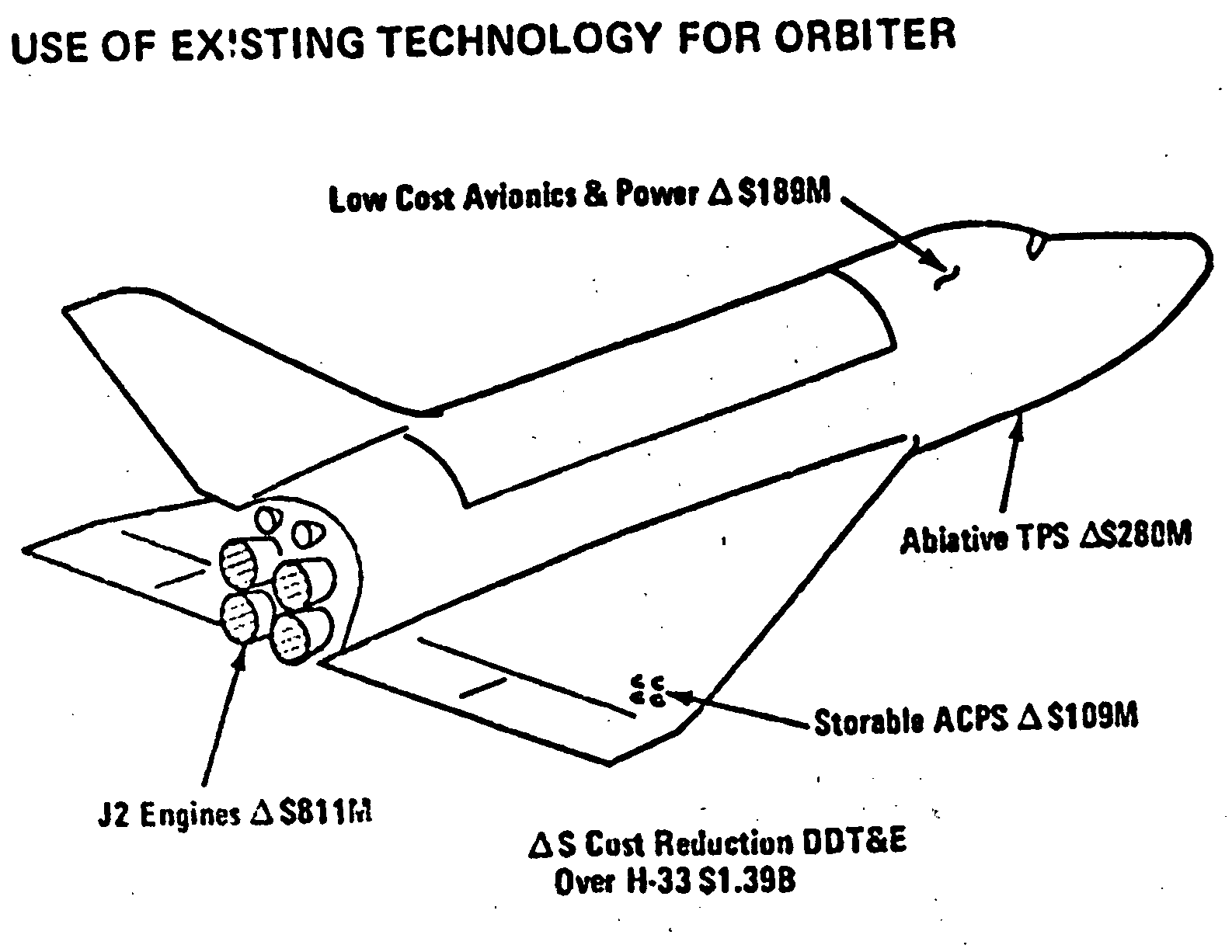
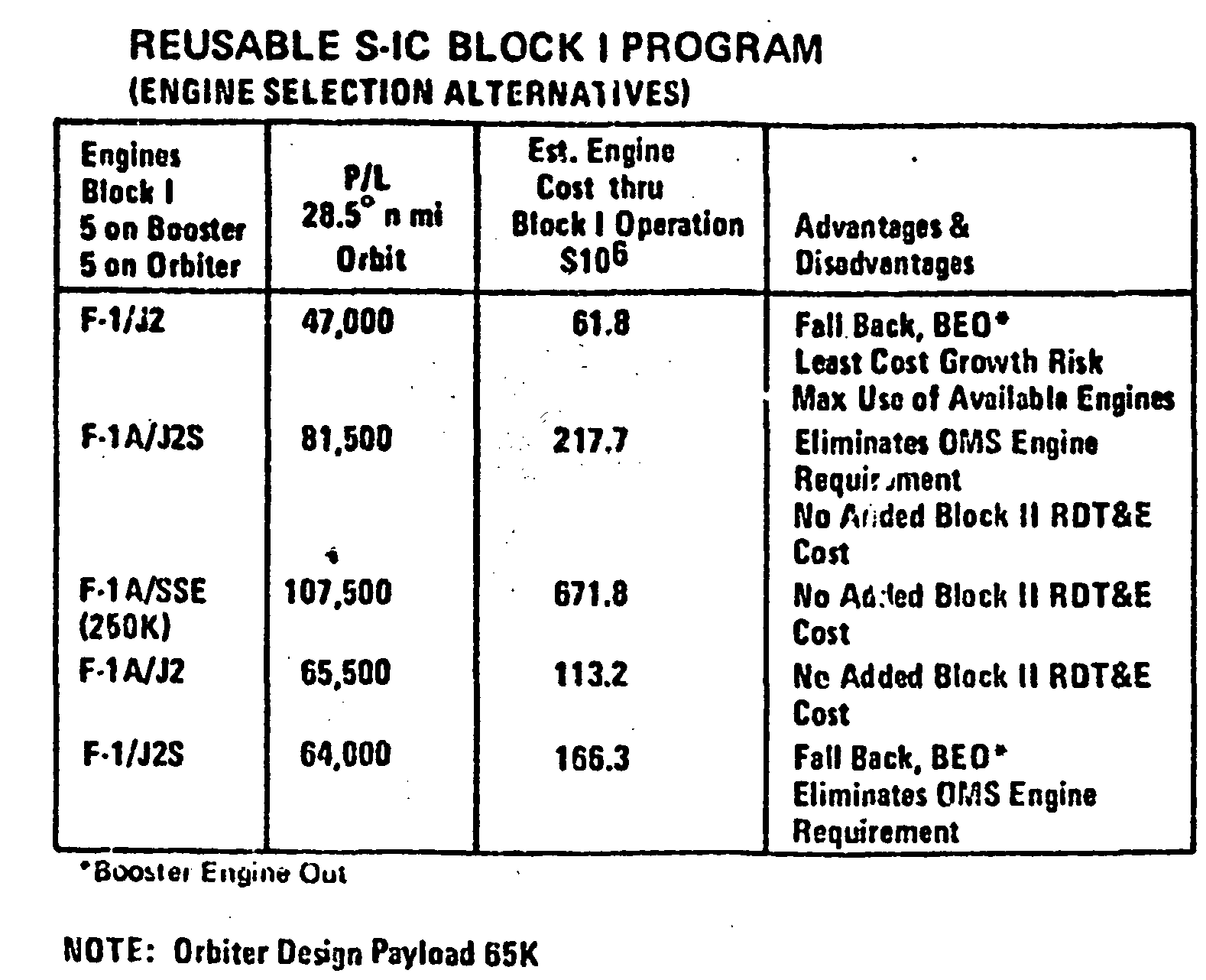
Of course, these costs only get us to our first flight. From here, everything depends on fixed and marginal costs, and how much the flight rate can attenuate the former in the direction of the latter. As we’ve already estimated, the difference between what they thought marginal flight cost would be during the design phase and what it actually proved to be is about a factor of 3. So, if we take this factor of three and apply it to the parameters of our chosen design, what we end up with is a 2026 per-flight cost of around 132 million. Given the payload it carries, this comes out at 4460 dollars per kg, a cost which would beat just about every launch vehicle on the market today, and coming close to the cost-to-consumer of the venerable Falcon 9. The latter comparison is a bit tricky, since it has been estimated that the marginal cost of the Falcon 9 to SpaceX is only a quarter of what it charges. Still, the Falcon 9 does not carry a crew of at least 4 on every launch, not to mention the fact that this vehicle would be online a good thirty years before it, attaining the operational maturity implied by the 1994 study a lot sooner than that date since we would expect it to fly more often, and possibly earlier too.
However impressive these marginal numbers might be, they mean little if an exorbitant fixed cost spoils the whole affair. So how would we go about estimating this element? I can think of two ways to do so. First, we could simply replicate the method we used before to gauge marginal cost. Since the Grumman Corporation helpfully provided us with an average flight cost estimate at three flights per year, both for the shuttle we chose and one that is similar to the real one, we can again calculate the difference and compensate for it. Using the given numbers of a 10.6 average at 445 flights and a 26.8 average at 3 (both in 1970 dollars), we end up with a fixed cost that’s 8.82 times lower than what it would actually be per the 1994 study. This is a considerable difference, and implies that the engineers at Grumman and Boeing were almost three times worse at estimating fixed costs than they already were at gauging per-flight costs. I would caution against this conclusion, however. It is all too likely that the calculations back in 1971 did not include a host of factors that the 1994 study would have included, like the legion of bureaucrats that takes care of everything not immediately related to launching space shuttles, but who wouldn’t be counted for that very reason. In the end, we make these calculations not to render judgment on 1970s fiscal planners, but to get a sense of the relative difference in fixed cost between the historical shuttle and any hypothetical alternative. Case in point, if we take this factor of 8.82 and apply it to the cost estimates for our design, we end up with a fixed cost of 1360 million dollars in 1994, which is about seventy percent of the actual amount. This implies that a more reusable shuttle does not lower fixed cost as much as it does marginal cost, which makes sense since you’re still working with much of the same bureaucracy and infrastructure.
The other way of estimating fixed cost is more direct: we go back to the 1994 zero base cost study once more, and see what we can cut from it on the basis of our chosen architecture. In general, this means exchanging the production lines making the real shuttle’s expendable elements for facilities geared towards maintenance and the occasional ordering of spare parts. Looking at the chart, we can see right away that anything related to the solid rocket boosters can be eliminated: that’s close to 400 million right there. When it comes to the external tank, I believe costs can be more than cut in half; while the two tanks won’t be two times smaller than the orange giant we’re familiar with, their dry weight (weight without propellant) will be more than three times less, and they are considerably simpler overall. Not only do they lack an interstage between the hydrogen and oxygen tanks, but they don’t need to bear the load of the orbiter, which would force the structure to be sturdier and require more involved attachment points. I would therefore dare to suggest that total cost can be cut by about two thirds, from 389 to 125 million. If I can find more detailed information on what the H-33 tanks were thought to cost absolutely, I’ll be happy to adjust that, but this is a guessing game at the best of times.
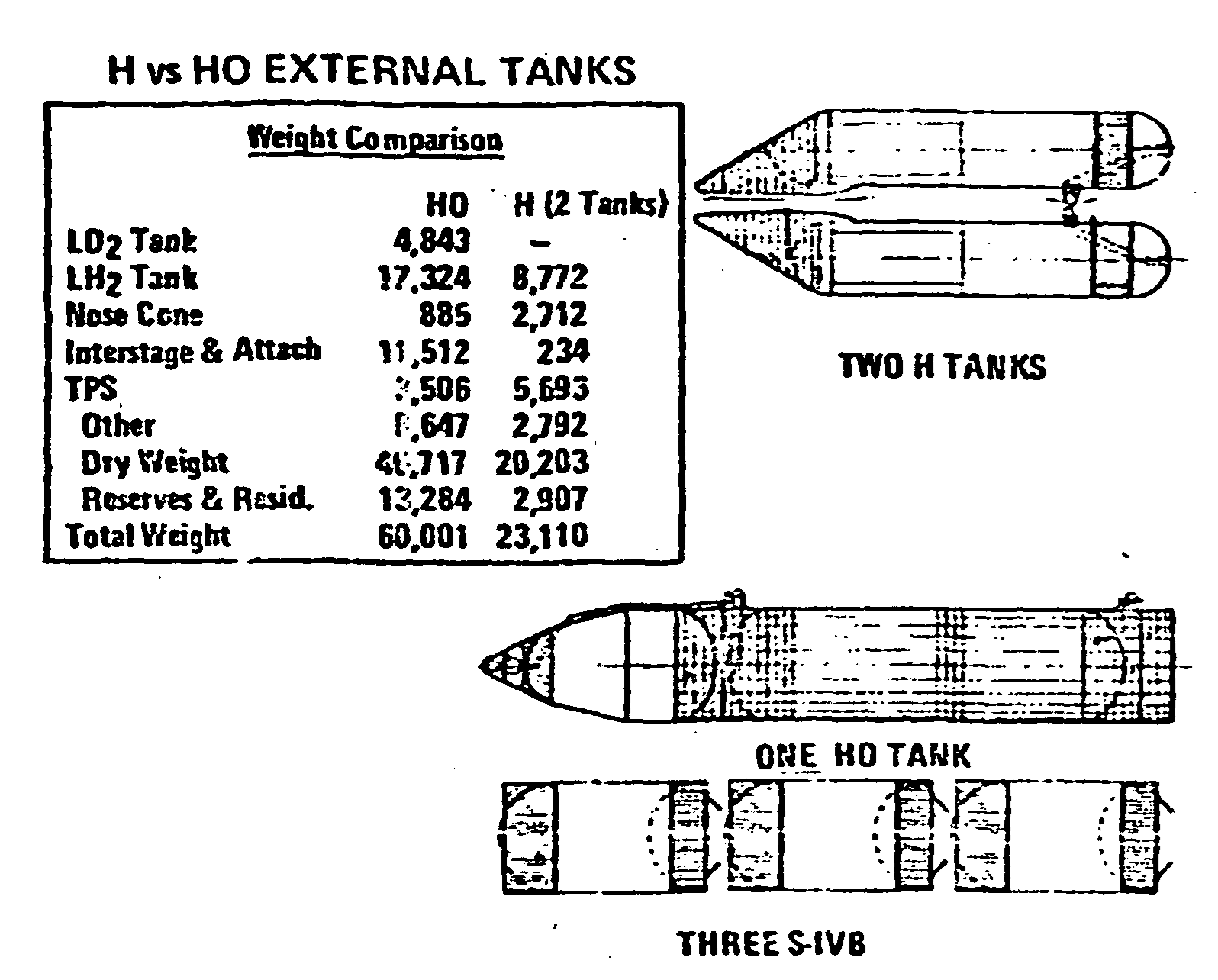
The H-33 HO tank would have been smaller than the historical Shuttle ET, hence its lower dry weight in this table
Estimating the difference in orbiter cost is even trickier. We can see that it adds up to around 240 million in total, including the engines, and here I would argue that our orbiter despite its increased size might still be cheaper.
To begin, the size difference only matters insofar as it causes additional maintenance across its surface and structure, as the internal systems are all going to be the same. Something I didn’t explicitly note before is that some of the subtler internals are actually better than the orbiter we got, since I made sure to include them in the research costs. I’m specifically talking about the Auxiliary Power Unit and Orbital Maneuvering System here, which on the real orbiter both used toxic hydrazine for fuel and propellant. Eliminating these systems was a commonly proposed upgrade during the shuttle program to enhance maintainability, and here we’ll do without them from the start. Hell, it appears that our selection of engine obviates the need for a separate orbital maneuvering engine entirely, which is just another of the small ways a space shuttle can be optimized if you’re willing to spend the money or make the right choices.
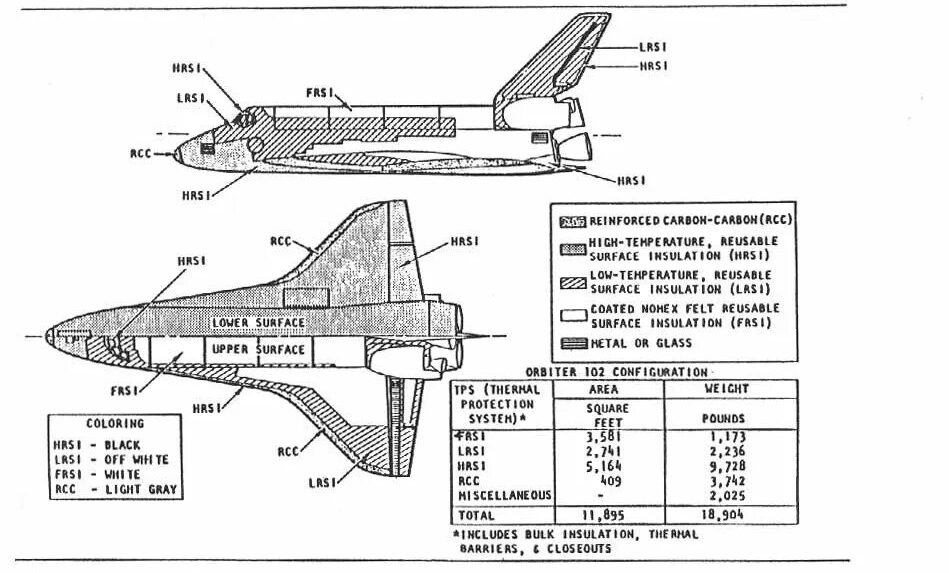
One part where orbiter size does make a difference in maintenance cost is in the application of the thermal protection system. One of the trickier parts of processing any orbiter—even undamaged TPS elements may need to be removed to get at the systems underneath—the savings in time and effort represented by the use of a titanium structure would be considerable, as can be seen by contrasting the TPS diagram we saw a little earlier with the one below; just about any area marked FRSI (which consists of thermal blankets, not tiles) could be left alone instead. Since this is about a third of the total surface area, that saves us a lot of trouble. As for the rest of the orbiter’s TPS, it would still benefit from the broader range of potential materials and attachment methods which a titanium substructure would allow. I’d be especially interested in any system that would be more impact resistant and would avoid the glues that gave the engineers some trouble in the early part of the program.
Lastly, the cost of the orbiter’s engines could go either way. Though the J-2S would be cheaper to develop and build than the Space Shuttle Main Engine, and would be far from expendable even in the worst-case scenario, I’m not sure it would be as maintainable as an engine designed for that purpose. Over time, it could receive many adjustments in that direction, but all of that remains speculation at best. All in all, I would venture a reduction in orbiter processing cost from 240 to around 180 million, though I’m happy to forego it since the real advantages of our changes are in processing time anyway.
Putting all our savings together and taking it off the whole of 2024 million (and then subtracting another 5% off that since that’s the cost of 1 flight and not 0) we end up with almost exactly 1250 million dollars—in 1994 of course. Note that this doesn’t even include the savings that could be made in other areas such as launch or mission operations (maybe 150 to 200 million put together), or the cascading effect where not having to deal with one part of the architecture saves people in other departments the need to consider it or liaise with its personnel. Regardless, to this 1250 million we would still need to add the fixed cost associated with the flyback booster. You might expect this massive stage to incur a large cost, but remember that it is far simpler than the orbiter, and doesn’t need as much refurbishment as the solid rocket boosters we got rid of. The 1998 study into liquid flyback boosters suggests that the operational cost of this kind of vehicle is less than a sixth of the SRMs, which in this case comes out to 60 million in fixed cost. Let’s be generous and round that up to 100. What you end up with is an annual fixed cost of 1350 million dollars, which is eerily close to the 1360 we got by our earlier calculation! I swear I didn’t engineer it that way; I just hope it proves the reliability of my method. Really though, I think it would be even lower than this, as with the cascading savings in other departments such as those related to operations, we could easily get down to 1150 or so. A shuttle which is easier to stack, fly, and get back to base reaps the rewards in just about every department.
At this point, one may wonder whether the method we’ve used to derive fixed cost directly from the 1994 study may also be applied to the estimation of marginal cost. The answer is ‘kind of’. If we subtract the system-based savings described above from the summed average of 127.9 million, we end up at around 90. This is before the marginal cost of the booster has been added back in, but is still quite a distance from the 57 million originally estimated. More importantly, it is also significantly more than what the 1998 LFBB study thought its configuration would cost at around 85 million (or 77 million in 1994 dollars). Since our shuttle ought to be even cheaper than that given the difference in orbiter, external tank, and so on, that’s pretty odd. We can explain it by considering that the cost of operation (launch, mission, payload, et cetera) is a much higher proportion of marginal cost than fixed cost in the 1994 study, and we haven’t really considered how much cheaper that would be with our shuttle. Moreover, the 1998 estimate already discounts total cost by 15% based on ‘expected reductions’, which I assume to be assorted operational changes since no big engineering changes were on the agenda in the late 90s. So, if we take another 20 million off our estimate based on how our different architecture would affect operations and then apply the fifteen percent discount after that—doing it the other way around would be cheating—we end up at 60 million instead. Add the 5 million the booster would cost proportionally, and we have a marginal per-flight cost of 65 million. This may still be too high since it doesn’t include the economy of scale that would reduce marginal cost at a high launch rate (note that the zero base cost study only goes up to ten), but we can afford to stick with the number we have given that it’s already half of what we started with.
At last, we have all the information we’d need to make an educated guess at what our optimized space shuttle would cost to operate in a given year. To hedge our bets a little bit, I would use our two methods in parallel: the one where we mathematically compensated for the 1971 numbers, and the one which modified the 1994 and 1998 numbers in a more granular fashion. Notably, where the former produced a lower marginal cost and a higher fixed cost, the latter did the opposite, which could help us in finding a relatively stable final estimate. Also, to make the comparison with the shuttle a little more fair, I would also like to provide a more ‘optimistic’ estimate of its economic performance, if only to show that our shuttle is still superior even when we steelman its alternative. With all that in mind, here is the table we get when putting all these numbers together:
| Marginal Cost Per Flight (millions of dollars) | 2026 dollars per kg to LEO, Marginal | Cost to Fly Once (millions of dollars) | Cost to Fly Ten Times A Year (millions of dollars) | Cost to Fly Thirty Times A Year (millions of dollars) | 2026 dollars per kg to LEO at ten flights | 2026 dollars per kg to LEO at thirty flights | |
| Shuttle Actual | 100-150 (1994), 230-350 (2026) | 7800-11700 | 2024 (1994) | 3205 (1994) | ~6400 (1994) | ~26,800 | ~17,900 |
| Shuttle Actual (Optimistic) | 107 (2006) | 6420 | 1973 (2006) | 2936 (2006) | 5076 (2006) | ~17,600 | ~10,200 |
| “Optimal Shuttle”: LH2 ET J-2S Orbiter with F-1A Booster (Original Estimate from 1971 using 1970 dollars) | 4.3 (1970), 44 (2026) | 1490 | 39.1 (1970) | 77.8 (1970) | 163.8 (1970) | 2691 | 1889 |
| Optimal Shuttle(1994+1998 Guesstimate) | ~65 (1994), ~150 (2026) | ~5070 | ~1215 (1994) | ~1800 (1994) | ~3100 (1994) | ~14,000 | ~8000 |
| Optimal Shuttle (Marginal Cost x3, Fixed Cost x8.82) | 57 (1994), 132 (2026) | 4200 | ~1420 (1994) | ~1930 (1994) | ~3070 (1994) | ~15,000 | ~8000 |
Personally, I think these results are simply marvellous. We can see that our shuttle approaches the same cost at a flight rate of thirty per year regardless of how you estimate it. I admit confirmation bias on my part may have had a hand in that, since in estimating shuttle marginal cost I tried to steer in the direction of that 57 million number. Still, there would need to be a massive mismeasure in my method for it to end up costlier than the historical shuttle, or even a hypothetical “Shuttle II” that would still be stuck with a large and dangerous external tank. Another thing to note is that the ‘optimistic’ row of results may be overstating its case a little, improving on both fixed and marginal cost by almost 40% from what was indicated during the 1990s. If we take a more realistic measure like the 15% we talked about and apply it to the first row, I believe we get a better sense of what a best-case shuttle would cost, which would be almost twice as much as the one we put together. Still, it’s telling that even naive numbers can’t make the existing shuttle compete with ours, even if it was able to keep up with it in terms of launch cadence.
This is what it all comes down to in the end: launch rate. Just about every shuttle design can be made economical, just as any of them can be made uneconomical by not flying at all. Two factors are most relevant in this area: turnaround time and safety. A shuttle should not suffer the kind of accidents that ground the entire fleet, nor should it take so long to refurbish that you need a massive fleet and a lot of personnel to maintain a given launch rate. Thankfully, our choice of design is informed by these considerations, as it uses relatively conventional recovery methods, is made of sturdy structures to forego extensive maintenance after each flight, and specifically avoids the two failure modes which destroyed Challenger and Columbia. While a spaceflight aficionado like myself can’t guarantee that this is the perfect vehicle, never to suffer any accident in a flight career that could last decades, I am confident that it is at the very least safer and cheaper than what we got, and thus far more likely to fly far more often.
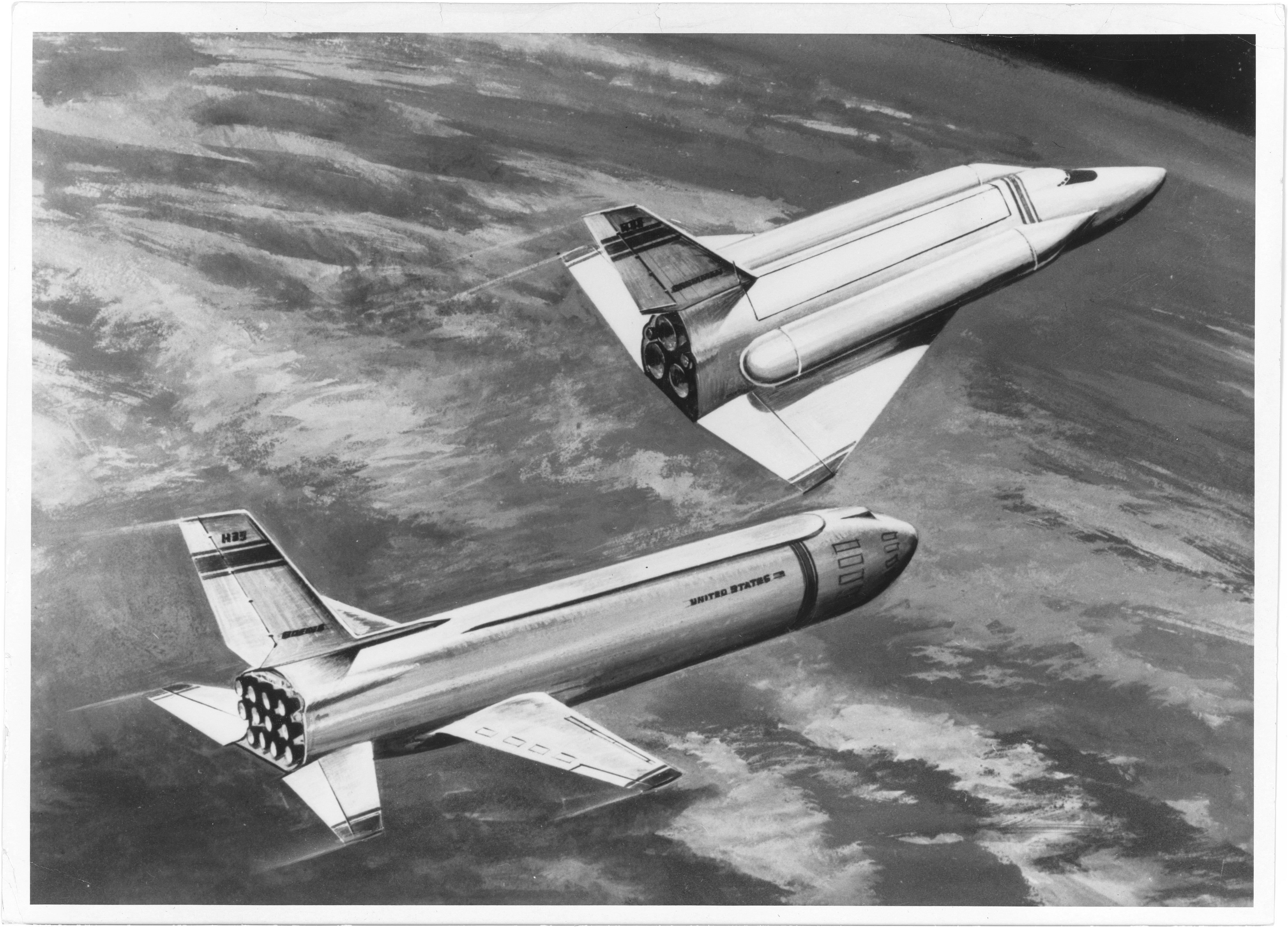
Not our shuttle exactly, but close enough to be representative
Fun and Profit
We are coming to the end of our investigation now, having answered those key questions that propelled us forward like a liquid rocket engine. Not only do we know what an “Optimal Shuttle” (trademark pending) would look like, we even have some sense of what it would cost to fly it. But like so many great questions, answering these only fuels our imagination further. The question is no longer whether a space shuttle program would be able to deliver on the promise of sharply reducing space launch cost, but rather how this capacity would be used. Naturally, I have some thoughts on that.
First, I would direct you to the table at the end of this essay, where I have compiled the costs of some non-shuttle launch vehicles for the sake of comparison. As you can see, even at ten flights a year, our design would be cost-competitive with anything European and American that flew in the 80s and 90s; the low cost of Russian rocketry is mostly related to their low labor cost during the misery of post-communism, but even these prices could be beat by a frequently-flying shuttle that also offers some of its passenger seats for sale. Next, let us consider the fiscal absurdity of the table above, which implies that it would be cheaper to launch our shuttle ten times than the historical one even once, or to launch ours thirty times for the price of ten regular ones. Since we know that NASA was willing to pay those three billion 1994 dollars for ten shuttle launches a year, that means they’d now have twenty more to find some purpose for.
If NASA launched thirty scientific payloads a year using the shuttle, that would be great, but it would only ‘make money’ in the sense that launching thirty expendable rockets would be far more expensive. What’s really interesting about our design is its commercial potential. Let’s suppose for a moment that NASA was to need only ten launches for its own purposes, content to take on the fixed cost since the average cost would still be far cheaper than what it usually spent on expendables. This would mean that the other twenty could be sold off at marginal cost, or, more realistically, at any cost that would be low enough to lure potential customers away from the competition. In a time when the competition would consist of launchers like the Ariane 4, around 5 times as expensive per orbital kilogram and without the capacity for a payload to be actively tended by a crew of experts, the profit margin on a commercial shuttle launch would be significant to say the least. If they sold for just three times the marginal cost—around forty percent cheaper than an Ariane or Atlas—then twenty such launches would make NASA 2.6 billion a year in 1994 dollars. To put it another way, the entire program of thirty launches would cost them half a billion a year, or 1.2 billion in contemporary dollars. If you’ll excuse my language, that is fucking ridiculous.
Yes, the secret success to a well working space shuttle is that it starts paying for itself before long. If NASA spun it off into a state-owned enterprise and then offered it a flat two-billion-for-ten-flights deal to take care of the fixed cost—perhaps exchanging this implicit subsidy for the right to buy additional flights at close to marginal cost—the entity thus created would be free to reinvest its profits into building the orbiters and infrastructure required for a higher flight rate, potentially making over five billion dollars in annual profit if they could launch fifty times a year.
But wait, there’s more! During the real shuttle program, all manner of upgrades were proposed in order to enhance the system’s performance and safety, some of which got quite far in before being unceremoniously canceled. The poor performance of the shuttle left it trapped in a kind of catch-22: it was so expensive to operate that it absorbed any of the funds that might have been used to improve or replace it. And really, even the most thorough upgrade program would have had a hard time overcoming the basic flaws of the external tank and thermal protection system. With our Optimal Shuttle, the situation could hardly be more different. Not only would the program be flush with cash owing to its commercial activities, but any upgrade it would consider could only strengthen its profit margin. It is in this context that I would propose two fundamental upgrade programs, each of which would dramatically enhance overall system performance while using the same basic parts and infrastructure. Both of them are also inspired by real shuttle proposals, which further enhances their plausibility.
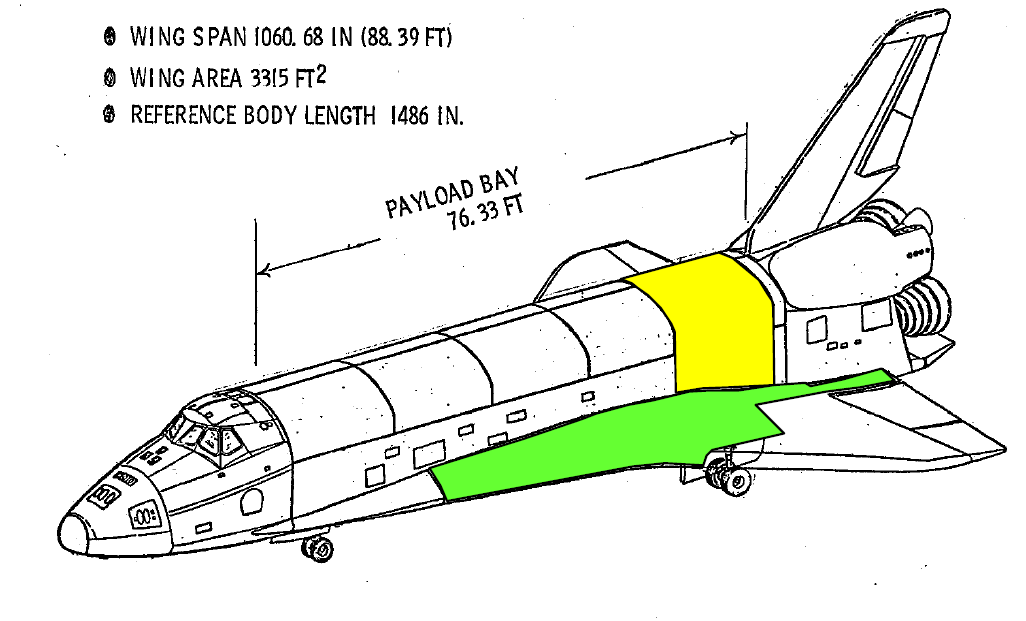
The first proposal is to make the orbiter longer and stronger. As you may have already noticed from an earlier table I shared on shuttle engine choice, combining an F-1A-powered booster with an orbiter that used 5 J-2S engines actually produces a payload capacity in excess of what the system is designed for—81,500 pounds instead of 65,000. One may expect the designers to anticipate this benefit and, in the course of fully developing the shuttle, already increase the orbiter’s payload capacity to something like 75,000 pounds. However, this would hardly be the best the shuttle can do. If during its first decade of operation, the J-2S engine could be improved further, its performance approaching that of the historical Space Shuttle Main Engine (SSME), then the total capacity would be around 107,500 pounds. Once again, the orbiter would not be designed to carry this load, and any combination of payloads that would be so heavy would likely be larger too. Thus, it would pay to try and make the orbiter bigger, the extra mass gained that way offset by the engine’s efficiency. If the booster’s engines can become a little more efficient too, it seems easy enough to me to get a total system that lifts 100,000 pounds, or 45,000 kilograms. Even if we assume this bigger orbiter would be more expensive to maintain, and add 5 million to the marginal cost, that still leaves us at a per-kilogram cost of 3000 to 3600 contemporary dollars. Need I point out that this is extremely cheap, especially for a vehicle that flies crew as well? Since the required technologies are no more complicated than the existing SSME, and would be developed about a decade later, its cost would fall entirely within what an already-profitable shuttle program could be expected to spend on system upgrades. The only question is whether the existing orbiters could be retrofitted for this stretched configuration; if they cannot, then entirely new vehicles would have to be built, which though more expensive could then benefit from lighter structural materials and other basic improvements, potentially enhancing total payload capacity further. All in all, it’s a relatively easy upgrade which will pay off handsomely.
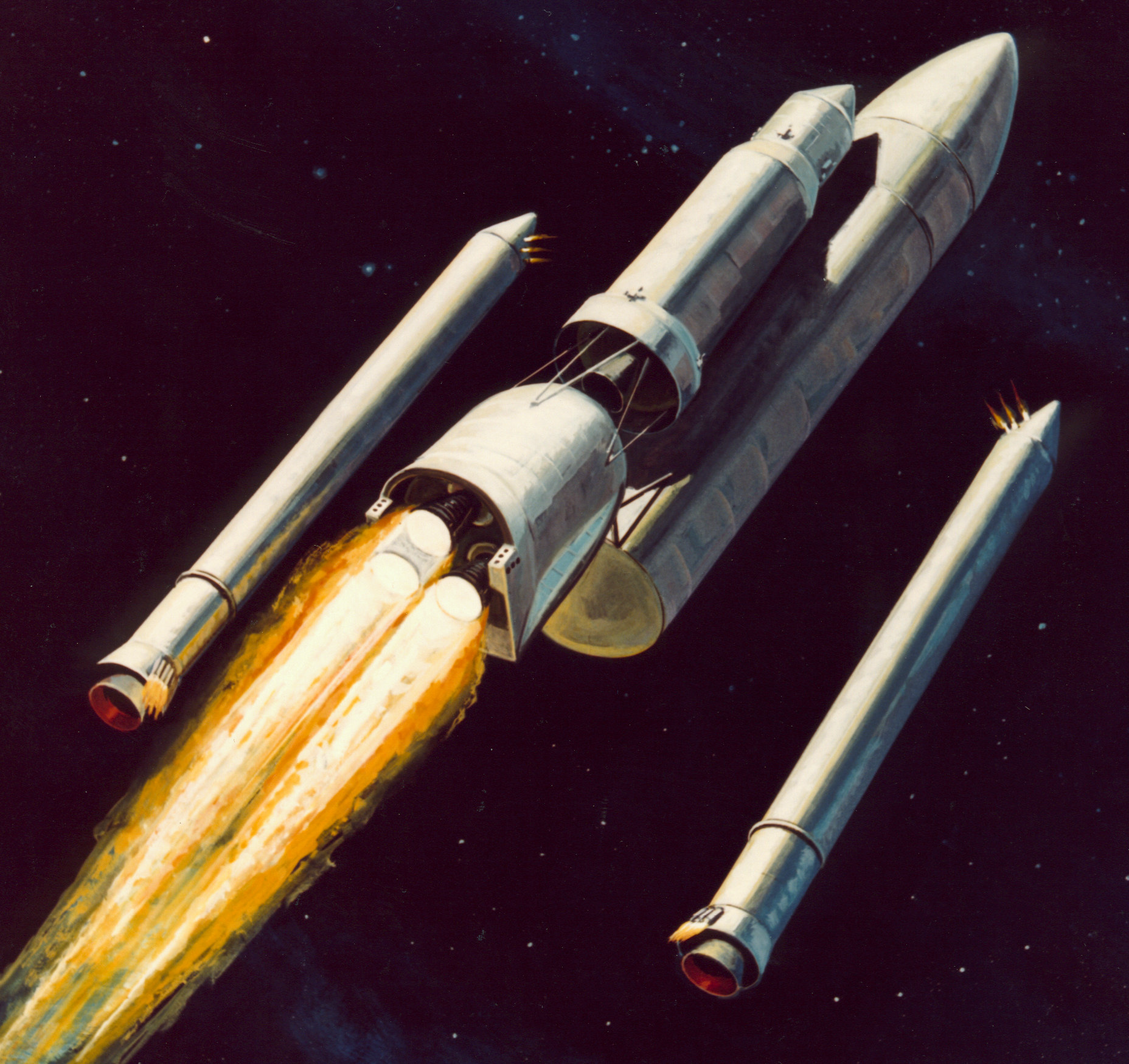
Somehow, it gets even better. Even before the first space shuttle launched, it was suggested that the vehicle ought to be complemented with a cargo-only version, sometimes called the Shuttle-C”, ditching the orbiter element to launch heavier payloads at presumably lower prices. Though many different proposals for such a vehicle exist—some of which were entirely expendable, which rather defeats the point of the architecture—the best among them packaged the shuttle’s engines and avionics into a reusable pod that could be recovered through a simple parachute landing. The obvious benefits which would come from such a design would apply to the Optimal Shuttle as well. For our purposes, though, we would want the avionics/propulsion pod to also include the orbiter’s reusable oxygen tank. While it would be hard to estimate the weight of such a pod, the proposed design added more than 100,000 pounds to what the shuttle could already carry. Since we’re cutting the same elements from our design, if not more since our orbiter is larger and the liquid oxygen tank could be packaged more efficiently as part of the pod, the real question is whether the additional pod weight plus the liquid hydrogen drop tanks we’re carrying anyway would weigh the same as the historical space shuttle external tank. My guess is that they would weigh less, but even if it’s about the same, we’d still end up with a vehicle that easily lifts 200,000 pounds, or around 90,000 kilograms. The marginal cost of this design would be considerably lower to boot, not having to bother with extensive orbiter thermal protection or anything to do with crew. Even if we’re exceedingly conservative and only drop it by only 5 million per flight, this means a cost per kg to orbit of between 1300 and 1600 contemporary dollars.
Again, these prices are insane, and beat just about anything on the market today. Back when this vehicle would have been ready for launch in the early 90s, you could have charged ten times this price and still beaten your competitors handily. The cost to develop it would also be miniscule compared to what would have been spent already, since all that would be needed in addition to the improved engines (a cost shared with the stretched shuttle) would be the recoverable pod. Developing this substantial upgrade in capability—and safety, since only the booster would carry crew in this configuration—would be an absolute no-brainer.
Conclusion
There you have it then. If our Shuttle could have proven its money-making capabilities in the 1980s, then the funds thus gained would have produced another leap in cheapening spaceflight in the 1990s. Taken together, it all sounds like a fantasy, but that’s exactly why I’ve sought to ground my story in research and napkin math every step of the way. While I don’t have the power yet to step back in time and stop the Nixon White House from cutting NASA’s feet out from under it, I hope this piece has given you a better sense of what the engineering and economics of the time could have allowed to be built. Perhaps a different president (like 1968 Democratic Party candidate Hubert Humphrey) would have let NASA keep enough of its budget to build a shuttle that could deliver on its promise of cheap and easy access to space. But even when we remember that none of that happened, the hypothesis alone carries many lessons for today. America’s aerospace industry has not escaped its dependence on government contracts, and there are plenty of other public projects throughout the world that run the risk of becoming less than useless through austerity.
For me, this little investigation is hardly at an end, as the enormous potential of an Optimal Shuttle program calls for another essay to substantiate it. Specifically, I would want to figure out what this vehicle would be used for exactly, and how the next generation of launch systems would build on its accomplishments. In this way, the alternate history implied by this piece would become all the more coherent, meaning we might ultimately imagine ourselves in a world that could have been significantly different despite its origin in a few engineering changes. But that’s a story for another time.

To be continued…
Postscript: Were they really that bad at estimating Shuttle costs?
Throughout this essay, we have had to adjust a lot of shuttle cost estimates upward in different ways, from a forty percent increase in development spending to a tripling of per-flight cost. Such adjustments might make it seem like the designers of the early 1970s were grossly inaccurate in their estimations, almost indicting the entire enterprise of aerospace economics. Once more, however, I would stress that these discrepancies can be explained without resorting to polemics. Put simply, the numbers we were trying to get to were not always the same as those that those provided; without more detailed statistics, it is impossible to say if the same factors were taken into consideration in 1971 as were in 1994. In general, the closer the compared statistics resembled one another—such as cost-to-first-flight, which is easy enough to find using annual shuttle program costs—the smaller the discrepancy became. And as I mentioned before, the point of using those older estimates was not to treat them as equal to more granular research like the Zero Base Cost Study, but rather to get a sense of the relative cost of different shuttle configurations, which I assumed to be about the same regardless of which cost factors were included. Thankfully, this assumption appears to have been vindicated, as the fixed and marginal cost of the Optimal Shuttle proved relatively stable whichever way we estimated it.
To really get a sense of what NASA officials thought the shuttle was going to cost, we have to look for those studies that were thought to be sufficiently sound at the time. Interestingly, NASA actually commissioned several outside firms to perform economic assessments of the shuttle, if only to guard themselves against the ire of the Office of Management and Budget (OMB). Insofar as these studies are brought up today, it is mostly to critique their estimated launch rate rather than their mathematical merit, so let’s start our own assessment there.
From the start, the costs of the shuttle were calibrated for a total launch rate of around 500 to 750 launches in the 1978-1990 period, a range that slowly declined towards its lower boundary as development went on. While these numbers might sound excessive, they did not come from nowhere. For instance, it was presumed that the shuttle would have an effective monopoly on US government space launches, whether civilian or military in orientation. Befitting the latter purpose, the vehicle was also expected to launch out of Vandenberg Air Force Base on the West Coast, which would have happened in real life were it not for the Challenger disaster. If the shuttle could count on a similar amount of payloads as during the 1964-1969 period, which already numbered more than fifty a year on average, it was entirely conceivable that the shuttle would get to fly enough times to justify its existence.
That said, even at the time, these estimates were not uncontroversial. The idea that an agency in the middle of a sharp budget contraction could expect the same launch rates it had at its height was sharply criticized. What these critics ignored however was that the lowering of launch costs would leave more money for building payloads, not to mention the fact that anything launched by the shuttle could become cheaper through the possibility of being serviced on orbit or brought up to earth for an upgrade. In fact, the external studies ordered by NASA showed that the overall savings to US space activities would primarily come from these downstream effects on payload economics, as can be seen from this table by the “Aerospace Corporation”:
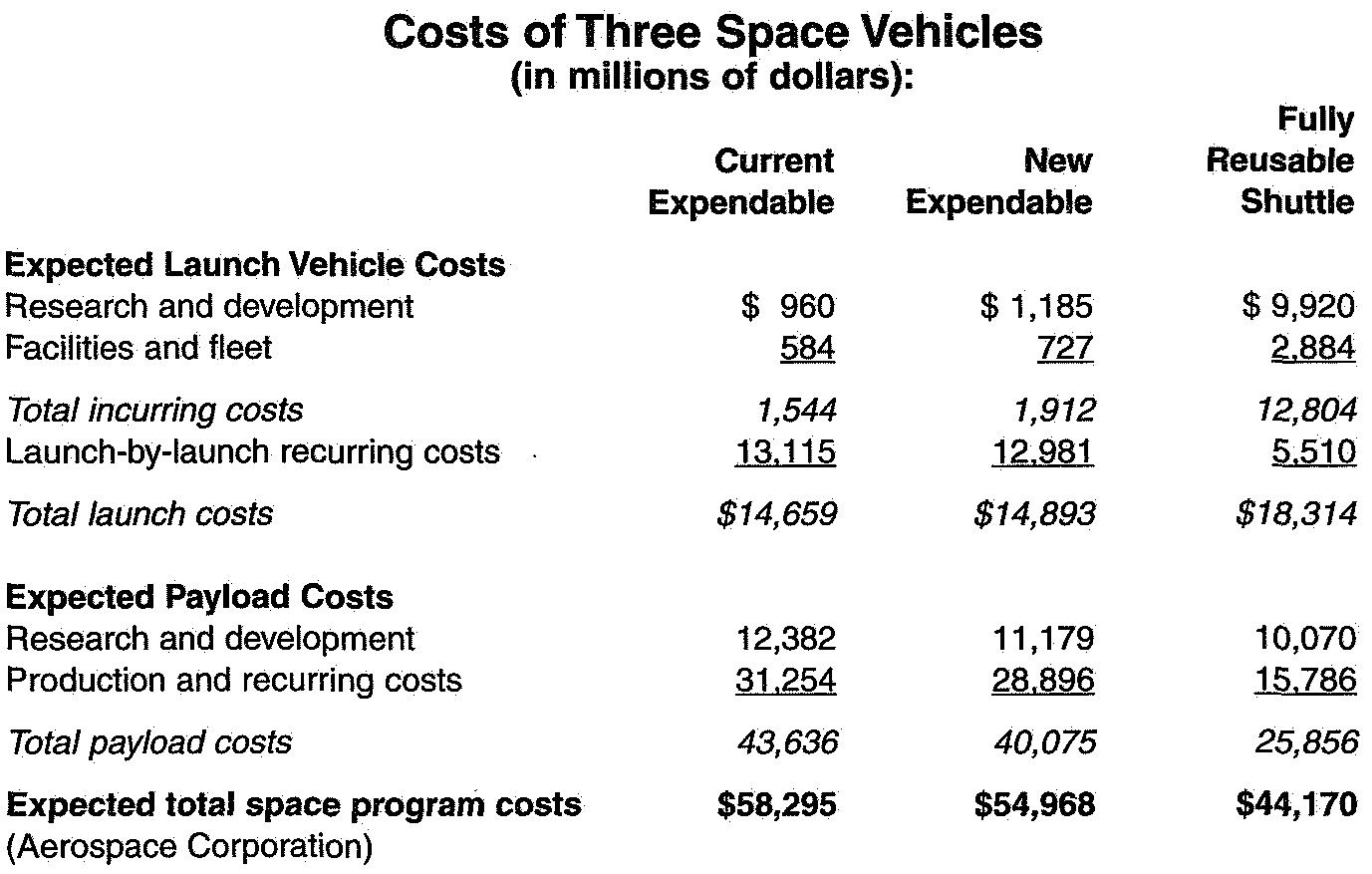
Incidentally, this table also gives us a sense of what reputable outside authorities—unburdened by the need to sell spaceships to NASA—thought a fully reusable shuttle was going to cost: 18 billion for 736 launches. One might expect the benefit of hindsight to spoil these expectations, but since we’ve actually done the math on our Optimal Shuttle, we have something to compare this 18 billion too. Allowing for 741 launches over 13 years and adding the cost-to-first-flight as a proxy for non-recurring costs, we come to a total of around 235 billion dollars today, or 24.5 billion dollars in 1971. This is a bigger cost overrun than one might like, about 34 percent, but it’s still smaller than any of the misestimates we’ve seen up to now, including the shuttle’s development cost overrun of about 40 percent. I hope this assuages any sense that the shuttle cost estimates of the time were fundamentally erroneous, at least when a reputable source was consulted.
Once we dare to trust these external studies, there are some interesting conclusions we can come to. The research performed by the firm Mathematica is especially interesting, given that it involves the notion of social discounting. Very basically, any money you might spend now is more valuable than the same amount of money in the future, if only because whatever is spent now can be expected to render a basic level of return in a given economic environment. By using a social discount rate of any arbitrary percentage, you treat your project as an investment that should pay off in savings or returns of at least that amount for every year that it goes on for. Given the huge upfront cost of developing a space shuttle, then, social discounting means that it must pay off even more than you would otherwise expect.
What may surprise you is that it does. Of the various ways that Mathematic used to evaluate the shuttle’s economic effectiveness, the most significant was its ‘equal budget’ method. While the reusable shuttle could be compared to its expendable competitors at any arbitrary amount of payloads (an ‘equal capacity’ method), the truth is that space budgets tend to be the more stable number than the number of space launches, as the latter adjusts to the former more than is the case in reverse. If the space shuttle was going to drastically reduce the money needed to launch X number of launches in the 1980s, it was more likely that more-than-X launches would be planned than that the program would simply cut itself down to that level. The shuttle’s value would not be in the money it saved, but in how much more value the space program would be able to deliver overall. Consider the graph above: instead of saying that the shuttle would save you 20% on total program costs, you could argue that it would give you ten to fifteen billion to spend on payloads and launches, each of which would be cheaper thanks to the new architecture and leave you with 34% more capacity overall. Measured in this manner, then, the space shuttle proved to be even more valuable, which in turn implied that more money could be spent to develop it. The ratio is quite staggering, in fact:
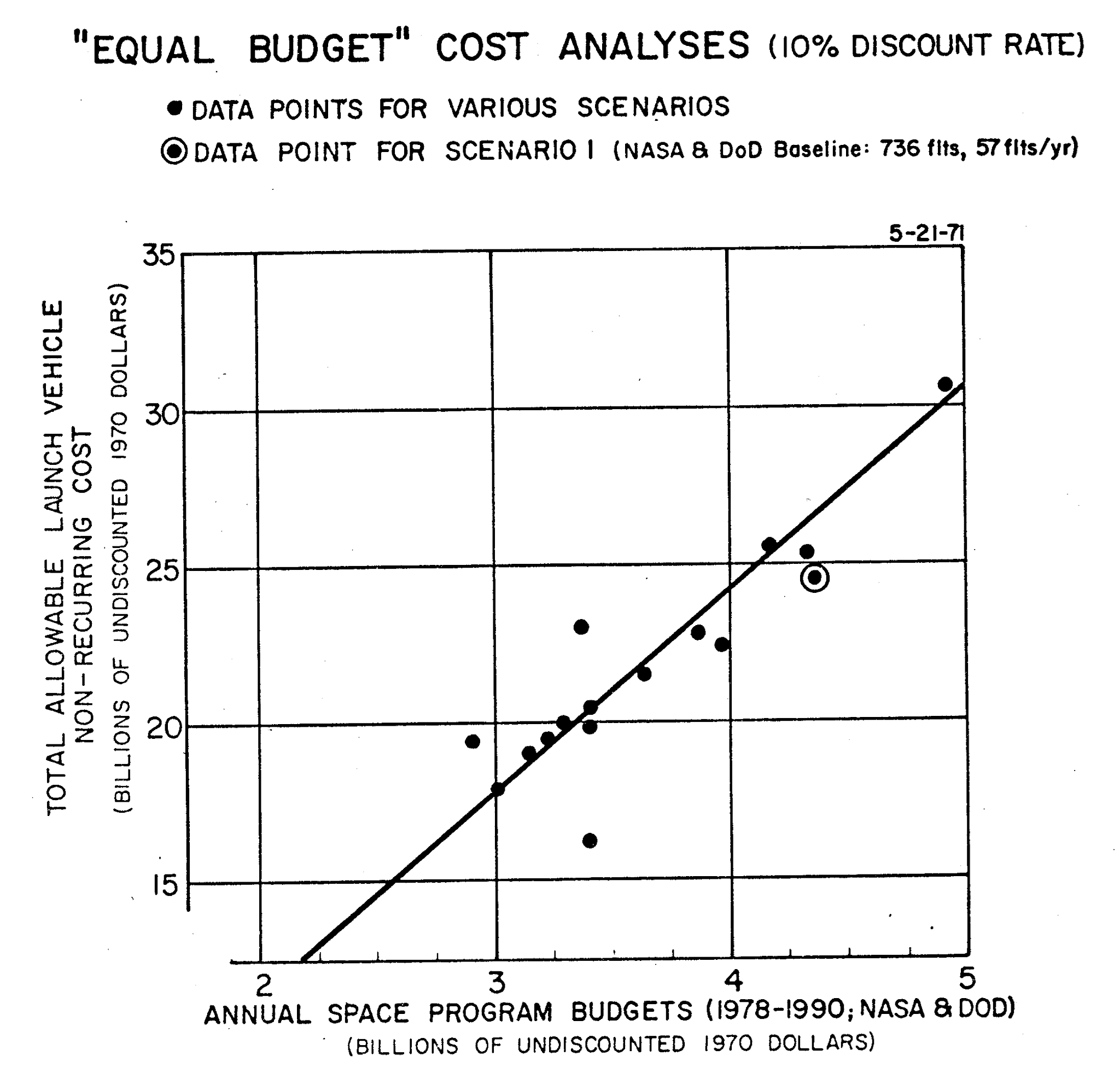
For any given number of launches, the equal-budget method allows for shuttle development costs well in excess of what even the most ambitious design was expected to cost (12.8 billion in 1970, which also includes a reusable space tug). Note that the space budget on the x axis includes that of the Department of Defense; even if we go by NASA’s real-life 1980s budget, though, around 2.4 billion per year, the full Phase B shuttle would still be worth funding. Of course, our Optimal Shuttle would be cheaper to develop and more expensive to launch, but the margins are still greater than what one might expect.
In hindsight, the real issue which spoiled these graphs—and I hate to sound like a broken record—is that the shuttle never got up to the flight rate it needed to be economical. But what I hope to have proved by now is that this was not because that cadence was too ambitious to aim for. In a broader context, there were Soviet launch vehicles at the time which were launched several dozen times a year, and recent history has shown that a fleet of reusable rockets like the Falcon 9 can rack up annual launch numbers into the hundreds. In a way, we do live in the future the shuttle promised us: it just came thirty years later than it might have.
Original Shuttle Cost Estimate Correction Table
Use this table to adjust cost estimates from shuttle design studies to a more realistic measure.
| Factor | |
| Cost to First Flight, Estimate to Actual | 1.4 |
| Marginal Cost, Estimate to Actual | 3 |
| Fixed Cost, Estimate to Actual | 8.82 |
| Marginal to Fixed Cost | 15-25 |
Table of Shuttle Design Cost Estimates
Note: Prices are per the year provided unless noted otherwise. 2026 dollars are calculated using NASA’s own New Start Inflation Index, which the agency uses to normalize historical mission costs. For reference, the factor between 1971 and 2026 is 9.599. Costs may deviate by 6.3% or 12.4% if sources from 1971 or 1972 respectively use 1970 dollars instead.
DDT&E: Design, Development, Testing, and Engineering.
FMOF: First Moment of Flight
MDAC: McDonnell-Douglas
GD: General Dynamics
| Design | Program Cost (billions of dollars) | Mission Cost (millions of dollars) | Payload to LEO (kgs) | Cost per kg to LEO (2026 Dollars) |
| SERV-MURP (Chrysler) | 10.092 (June 1971) 6.530 DDT&E (June 1971) | 4.21 (June 1971) 5.07 (June 1971, amortized over 445 flights), | ~29,500 | 1370-1650 |
| Two-Stage Fully Reusable (Lockheed) | 9.8 (Nov 1971) | 3.8 (Nov 1971) | 29,500 | 1240 |
| LS400-7A Two Stage Fully Reusable (Lockheed) | 9.016 (June 1971) | 5.15 (June 1971) | ~36,000 | ~1370 |
| External Hydrogen + Flyback Booster (Lockheed) | 10.144 (Nov 1971) | 5.16 (Nov 1971) | 29,500 | 1680 |
| LS-200-11 Stage-and-a-half (Lockheed) | 6.64 (Nov 1971) | 5.62 (Nov 1971) | 33,000 | 1830 |
| External Hydrogen/Oxygen + Flyback Booster (Lockheed) | 10.064 (Nov 1971) | 5.68 (Nov 1971) | 29,500 | 1850 |
| RATO (Lockheed) | 9.7 (Nov 1971) | 13.5 (Nov 1971) | 29,500 (?) | 4390 (?) |
| Two-stage Fully Reusable (MDAC-Martin) | 13.297 (Nov 1971) | 4.03 (Nov 1971) | 29,500 | 1310 |
| Two-Stage Reusable External Hydrogen (MDAC-Martin) | 12.312 (Nov 1971) 13.252 (Nov 1971, later version, includes interim booster) | 4.61 (Nov 1971) 4.13 (Nov 1971, later version) | 29,500 | 1340-1500 |
| External Hydrogen/Oxygen + Flyback Booster (MDAC-Martin) | 12.972 (Nov 1971, includes interim booster) | 4.62 (Nov 1971) | 29,500 | 1500 |
| External Hydrogen/Oxygen + F-1 Flyback Booster (MDAC+Martin) | 12.878 (Nov 1971) | 5.99 (Nov 1971) | 29,500 | 1950 |
| External Hydrogen/Oxygen + Recoverable Pressure-Fed Booster (MDAC-Martin) | 9.916 (Nov 1971) 10.798 (Mar 1972) 5.676 DDT&E (Mar 1972) | 6.05 (Nov 1971) 7.50 (Mar 1972) | 29,500 | 1970-2440 |
| External Hydrogen/Oxygen + Recoverable F-1 Booster (MDAC-Martin) | 10.002 (Mar 1972) 5.018 DDT&E (Mar 1972) | 7.56 (Mar 1972) | 29,500 | 2460 |
| External Hydrogen/Oxygen+ Parallel-Staged Solid Boosters (MDAC-Martin) | 10.418 (Nov 1971) 9.816 (Mar 1972) 4.313 DDT&E (Mar 1972) | 9.94 (Nov 1971) 9.49 (Mar 1972) | 29,500 | 3090-3230 |
| External Hydrogen/Oxygen + F-1 Flyback Booster (Rockwell-GD) | 9.91 (1971) | 5.6 (1971) | 29,500 | 1820 |
| External Hydrogen/Oxygen + Recoverable F-1 Booster (Rockwell-GD) | 8.9 (Mar 1972) 4.2 DDT&E (Mar 1972) | 7.5 (Mar 1972) | 29,500 | 2440 |
| External Hydrogen/Oxygen + Recoverable Pressure-Fed Booster (Rockwell-GD) | 9.74 (1971) 9.4 (Mar 1972) 4.6 DDT&E (Mar 1972) | 7.9 (1971) 7.6 (Mar 1972) | 29,500 | 2470-2570 |
| Expendable Second Stage+Reusable Booster (Rockwell-GD) | 30.5 (Jun 1971) | 95,000 | 3080 | |
| External Hydrogen/Oxygen + Series-Staged Solid Booster (Rockwell-GD) | 10.8 (Mar 1972) 3.7 DDT&E (Mar 1972) | 13.7 (Mar 1972) | 29,500 | 4460 |
| H-33 (Boeing-Grumman) | 7.1 at FMOF (Nov 1971) | 4.2 (Nov 1971, Boeing) 4.47 (Nov 1971, Grumman, 445 flight average, 1970 dollars) 4.5 (1971 Boeing, amortized) 15.6 (Nov 1971, Grumman, 12 flight average at 3 flights per year, 1970 dollars) | 29,500 | 1370-1550 |
| Phase B Fully Reusable (Boeing-Grumman) | 7.0 DDT&E at FMOF (1971) | 4.5 (1971, amortized) | 29,500 | 1460 |
| External Hydrogen, J-2S Orbiter, F-1A Flyback Booster (Boeing-Grumman) | 3.645 DDT&E at FMOF (Block I) (Sep 1971, 1970 dollars) 5.31 at FMOF (Block I) (Nov 1971, 1970 dollars) | 4.3 (Sep/Nov 1971, 445 flight average, 1970 dollars) 15.9 (Sep/Nov 1971, 12 flight average at 3 flights per year, 1970 dollars) | 29,500 | 1490 |
| External Hydrogen/Oxygen + Pump-fed Ballistic Recoverable Booster (Boeing-Grumman) | 8.66 (Mar 1972) 4.213 DDT&E (Mar 1972) | 6.62 (Mar 1972) | 29,500 | 2150 |
| External Hydrogen/Oxygen + F-1 Flyback Booster (Boeing-Grumman) | 4.49 DDT&E at FMOF (1971) | 6.7 (1971, unamortized) 8.2 (1971, amortized) | 29,500 | 2180-2670 |
| External Hydrogen/Oxygen + Pressure-fed Ballistic Recoverable Booster (Boeing-Grumman) | 9.35 (Mar 1972) 4.72 DDT&E (Mar 1972) | 7.07 (Mar 1972) | 29,500 | 2300 |
| External Hydrogen/Oxygen + Throwaway Solid Boosters (Boeing-Grumman) | 4.25 at FMOF (Sep/Nov 1971, 1970 dollars) 3.85 DDT&E (Mar 1972) 10.46 (Mar 1972) | 10.6 (Sep/Nov 1971, 445 flight average,1970 dollars) 26.8 (Sep/Nov 1971, 12 flight average at 3 flights per year, 1970 dollars) 13.1 (Mar 1972, Boeing) | 29,500 | 3670-4030 |
| Actual Shuttle | 6.31 at FMOF (1971) 60.58 at FMOF (2026) 196 (136 flights over 30 years, 2011) 276 (136 flights over 30 years, 2026) | 63 (1985, marginal cost) 418 (2006, annual average at six flights per year) 520 (1997, cost per flights over eight flights) ~1700 (2018, program average) | 27,500 | 6420 (marginal) 25,080 (annual six flight average) 36,110 (1997 average) ~80,000 (program average) |
| Shuttle “Dream Survives” (Marginal Cost Based On 1994 Zero Base Study) | ~100-150 (1994) ~230-350 (2026) | 29,500 ( FWC SRBs) | ~7800-11700 | |
| Shuttle II “Dream Survives” (Marginal Cost Based On 1998 LFBB Report) | ~85 (1998) ~180 (2026) | 34,000 ( Upgraded Orbiter and LFBBs) | ~5300 | |
| This Essay’s Optimal Shuttle | ~9-9.5 at FMOF (1971) ~20.5 (450 launches over 15 years, 1971) ~25 (750 launches over 15 years, 1971) ~20 (500 launches over 10 years, 1971) ~200 (450 launches over 15 years, 2026) ~240 (750 launches over 15 years, 2026) ~190 (500 flights over 10 years, 2026) | ~132-150 (2026) | 29,500 | ~4460-5070 |
| Optimal Shuttle Stretched | ~140-160 (2026) | 45,000 | ~3000-3600 | |
| Optimal Shuttle-C | ~115-140 (2026) | ~90,000 | ~1300-1600 |
Table of Non-Shuttle Launch Vehicles
Note: Prices are per the year provided. 2026 dollars are calculated using NASA’s own New Start Inflation Index, which the agency uses to normalize historical mission costs.
| Vehicle | Mission Cost (millions of dollars) | Payload to LEO (kgs) | Cost per kg to LEO (2026 Dollars) |
| Saturn V | 728 (2018) | 140,000 | 6700 |
| Ariane 44L (European 80s-90s medium launcher) | ~125 (2000) | 10,200 | ~24,200 |
| Ariane 5 (European 2000s-2010s medium-heavy launcher) | 178 (2018) (ECA version) | 20,000 (ECA version) | 11,500 |
| Ariane 6 (European contemporary launcher) | 115 (2018) (A64 version) | 21,650 (A64 version) | 6860 |
| Soyuz 2.1 (Russian 2000s-2020s medium launcher) | 35 (2018) | 8,670 | 5220 |
| Proton-K (Soviet/Russian heavy launcher) | 40 (1994) | 20,000 | 4600 |
| Titan 34D (American 1980s medium launcher) | 90-110 (1988) | 14,515 | 18,290-22,360 |
| Atlas G/Atlas I (American 1980s-1990s medium launcher) | 70.3 (1994) | 5,900 | 27,420 |
| Atlas V (American 2000s-2020s medium launcher) | 109-179 (2018) | 8,123-18,814 | 12,290-17,340 |
| Delta II (American 1990s-2010s light-medium launcher) | 51 (1987) | 6,107 | 25,950 |
| Delta IV Heavy (American 2000s-2020s medium-heavy launcher) | 350 (2018) | 28,370 | ~16,000 |
| Vulcan Centaur (American contemporary medium-heavy launcher) | ~120-150 (2026) | 27,200 (VC6 version) | ~4400-5500 |
| Rocket Lab Neutron | 50-55 (2026) | 13,000 | ~4200 |
| New Glenn | ~110 (2026) | 45,000 | ~2450 |
| Falcon 9 Cost To Client | 74 (2026) | 17,500 (reusable) | 4200 |
| Falcon Heavy | 150 (2022, expendable) ~90 (2018, side boosters recovered) | 63,800 (fully expendable) ~57,000 (side boosters recovered) | 2040-2660 |
Sources Used
Historical Volumes
Space Shuttle Decision by T.A. Heppenheimer: a great history of how and why the space shuttle was designed.
A Shuttle Chronology: 1964-1973 by John F. Guilmartin Jr. and John W. Mauer, with archival support by Janet Kovacevich: an amazing compendium of all the political and technical decisions that went into designing the space shuttle, very detailed with lots of enlightening excerpts.
The Untold Stories of the Space Shuttle Program by Davide Sivolella: a collection of some of the many space shuttle program proposals that weren’t. Primarily focused on the post-1972 period.
Space Shuttle Cost Analysis: A Success Story? by Humboldt C. Mandell Jr.: An academic presentation looking back at shuttle cost estimates. Largely agrees with my own conclusions, though it doesn’t take the potential of an alternate configuration into account, naturally.
An Introduction to Future Launch Vehicle Plans 1963-2001 by Marcus Lindroos: A website from almost 25 years ago which compiles a lot of information on reusable launch vehicle designs. You’ll need to use the Wayback Machine to see the associated graphs and images, though.
Shuttle Variations and Derivatives That Never Happened – An Historical Review by Carl F. Ehrlich Jr. and James A. Martin: A 2004 study of decades of shuttle upgrade proposals, including illustrations for many of them, such as the ones for the stretched orbiter and recoverable engine pod used in this essay.
Primary Sources
(Grumman) Proposal to Accomplish Phase B Space Shuttle Program, March 30 1970: Grumman’s proposal to build a fully reusable Phase B shuttle. While it didn’t get selected, this led them to start working with Boeing on what eventually became the H-33. It also includes an early design of a booster/orbiter combination using existing F-1/J-2-derived engines.
(Lockheed) Study of Alternate Space Shuttle Concepts, Final Report, Volume II Part II: Concept Analysis and Definition, June 2 1971: Part of a larger report, contains a detailed design by Lockheed of a two-stage fully reusable system.
(Rockwell-GD) Phase B Final Report, Expendable Second Stage, Reusable Space Shuttle Booster, Volume I: Executive Summary, June 25 1971: The Rockwell-GD team’s report on using the shuttle’s booster with an expendable second stage, proving relatively cost-competitive due to the higher payloads this enables, albeit at the expense of any crew capacity.
(Chrysler) Single-Stage Earth-Orbital Reusable Vehicle, Space Shuttle Feasibility Study, Volume I: Summary, June 30 1971: Chrysler’s report on its SERV system. Notable for being an exceedingly pleasant read as far as these things go; great graphs and general layout!
(Boeing-Grumman) Alternate Space Shuttle Concepts Study, Part II Technical Summary, Volume II Orbiter, July 6 1971: A useful if fragmentary source on Boeing-Grumman’s H-33 design, specifically focused on the orbiter.
(Boeing-Grumman) Alternate Space Shuttle Concepts Study: Design Requirements and Phased Programs Evaluation, Midterm Review, September 1 1971: The Boeing-Grumman team’s progress report on making the shuttle cheaper to develop somehow. My primary source for the HJ2-RSIC design (AKA the Optimal Shuttle).
(Lockheed) Alternate Concepts Study Extension, Volume 1: Executive Summary, November 15 1971: Lockheed’s investigation of different configuration and program types, contains a useful comparison of External Hydrogen versus Hydrogen/Oxygen systems.
Space Shuttle – Skylab: Manned Space Flight in the 1970s, Status Report for the Subcommittee on NASA Oversight of the Committee on Science and Astronautics, January 1972: Despite its unwieldy title, perhaps the most useful of all my primary sources, as it contains transcripts of several briefings to the US Congress by NASA contractors in November of 1971. This makes it a perfect snapshot of the technical and fiscal state of play around this date; the presentation slides included are also adapted to be more easily grasped than these technical documents usually are. All the major space shuttle teams are included, so wherever the date cited in my shuttle cost table is November 1971, this is probably the source for that.
(Rockwell-GD) Space Shuttle Phase B’’ Final Report, Volume I. Executive Summary, March 15 1972: The Rockwell-GD team’s final report, leaning towards series-staged recoverable liquid boosters “if meeting all cost goals is the major criteria”.
(Boeing-Grumman) Space Shuttle System Program Definition, Phase B Extension Final Report, Executive Summary Volume I, March 15 1972: The Boeing-Grumman team’s final report, skeptical of parallel-staged SRBs in favor of a recoverable LRB.
(MDAC) Space Shuttle Phase B System Study Extension Final Report, Part I: Executive Summary, March 15 1972: McDonnell Douglas’ final report on Phase B of the space shuttle program, recommending a system similar to the one we ended up with.
(Boeing) Propulsion System Advances That Enable A Reusable Liquid Fly Back Booster (LFBB) by E.L. Keith and W.J. Rothschild, July 1998: A Boeing report on the Shuttle’s LFBB upgrade, notable for including the cost savings estimate used in this essay.
Other Sources
Economic Analysis of New Space Transportation System, Executive Summary, May 31 1971: The exhaustive study of shuttle economics performed by the firm Mathematica. Notable for using social discounting and coming at the problem of comparing systems from different angles (same-capacity versus same-budget).
Shuttle Operations Zero Base Cost Study, Presentation to Dr. Lenoir, July 2 1991: The ever-useful zero base cost study. Despite the date, it uses FY1994 numbers, likely derived using NASA’s own inflation index.
Space Shuttle Costs: 1971-2011 by Roger Pielke Jr.: A good online overview of what the actual shuttle program cost year by year.
The Annual Compendium of Commercial Space Transportation: 2018: a dated but still useful source on what certain contemporary commercial launch vehicles cost per launch.
2023 NASA New Start Inflation Index For FY24: The most recent version of NASA’s inflation index I could find, which thankfully includes the covid-era inflation spike into consideration.


